Friday, September 14, 2012
Friday, September 7, 2012
Wednesday, August 29, 2012
Anne Braden: Southern Patriot
Anne Braden: Southern Patriot (1924-2006) is a first person documentary about the extraordinary life of this American civil rights leader. Braden was hailed as a white southerner who was “eloquent and prophetic” by Dr. Martin Luther King Jr. in his 1963 Letter from Birmingham Jail. Ostracized as a “red,” she fought for an inclusive movement community and mentored three generations of social justice activists.
www.annebradenfilm.org
The film is an Appalshop documentary by Anne Lewis & Mimi Pickering 77 min, 2012 ·
“Anne Braden's life stories drill down to the roots of the country's struggles for Civil Rights and Civil Liberties. I salute Anne for the extraordinary courage of her life.” - Bob Moses, former Mississippi SNCC field secretary and founder, Algebra Project
“If it was Rosa Parks and Martin Luther King who convinced me to join the struggle, it was Anne Braden who showed me how to do it.” - Bob Zellner, SNCC's first white staff member
“I go to these meetings and people talk about how we've got to build better relations and I say, 'First of all we've got to deal with this whole issue of white supremacy,' and it's like you threw a snake on the table. But I don't care. I'll be obnoxious.” - Anne Braden
Anne Braden: Southern Patriot is a first person documentary about the extraordinary life of this American civil rights leader. Braden was hailed by Dr. Martin Luther King Jr. in his 1963 “Letter from Birmingham Jail” as a white southerner whose rejection of her segregationist upbringing was “eloquent and prophetic.” When charged with sedition for attempting to desegregate a Louisville, Kentucky neighborhood in 1954, Braden used the attack to embark upon a lifetime of racial justice organizing matched by few whites in American history. Ostracized as a “red,” she fought for an inclusive movement community and demonstrated that civil liberties were essential for civil rights.
After decades of being shunned by even the most progressive organizations, in 1989 Anne Braden was awarded the first Roger Baldwin Medal of Liberty from the American Civil Liberties Union as a “lifelong leader of the movements for racial justice, labor rights, and peace in the South.” Described as “one of the great figures of our time” by historian Jacquelyn Hall, Braden died in 2006 leaving a remarkable legacy as a grassroots organizer, committed journalist, civil rights leader, movement strategist, social chronicler, public intellectual, teacher and mentor to three generations of social justice activists. In the midst of production at the time, the filmmakers continued with the documentary with other producers graciously contributing additional media.
In the film Braden is articulate, insightful, challenging, self-effacing, and charming. Her reflections on the significance of a lifetime of racial justice organizing are interspersed with commentary from civil rights leaders, organizers, historians, students and friends who intersected with her at key moments in her life. Archival material of the civil rights movement and historical and contemporary footage of Anne participating in the social justice community are juxtaposed with a variety of interviews. In a time of war, terrorism, economic uncertainty, religious controversies and an African American President, unresolved issues around race and racial justice, civil rights and civil liberties, class and gender equity inform our national debates.
Braden engages audiences with a unique southern voice for a much needed discourse on the continuum of struggle for civil rights and civil liberties from the founding of our democracy to the present, and the responsibilities of whites to join the fight against racism and white privilege. Through this exploration of Anne Braden's story we see not only the dangers of racism and political repression but also the power of a woman's life spent in commitment to social justice.
About the Filmmakers
Anne Lewis is an independent documentary-maker associated with Appalshop and currently a Senior Lecturer at the University of Texas-Austin School of Radio/Television/Film. Her work reveals working class people fighting for social change. Anne was associate director/assistant camera for Harlan County, U.S.A., the Academy Award-winning documentary about the Brookside strike. After the strike, she moved to the eastern Kentucky coalfields where she lived for 25 years. Documentaries she produced, directed, and edited include: To Save the Land and People (SXSW, Texas Documentary Tour) a history of a militant grassroots environmental movement; Justice in the Coalfields (INTERCOM gold plaque) about the community impact of the Pittston strike; On Our Own Land (duPont-Columbia Award for independent broadcast journalism) about the citizens' movement to stop broad form deed strip mining; Chemical Valley, co-directed with Mimi Pickering (P.O.V., American Film and Video Blue Ribbon) about environmental racism; and most recently, Morristown, a working class response to globalization. Her documentary Fast Food Women about women struggling to raise families in minimum wage jobs with no benefits received national airing on P.O.V. and was part of a Learning Channel series of films about women by women.
Mimi Pickering is a Guggenheim award-winning filmmaker and director of Appalshop's Community Media Initiative (CMI). Pickering's documentaries often feature women as principle storytellers, focus on injustice and inequity, and explore the efforts of grassroots people to address community issues and organize for positive solutions. In 2005, her film The Buffalo Creek Flood: An Act of Man was selected by the Librarian of Congress for inclusion in the prestigious National Film Registry. Other award-winning documentaries include Chemical Valley, an examination of environmental racism co-directed with Anne Lewis; Dreadful Memories: The Life of Sarah Ogan Gunning explores the legacy of this singer/songwriter whose hauntingly beautiful ballads were written from her experiences in Kentucky's strike-torn coalfields of the 1930s; Hazel Dickens: It's Hard to Tell the Singer From the Song celebrates this West Virginia singer/songwriter and powerful social chronicler described by the Washington Post as “a living legend of American music, a national treasure.”
About Appalshop, the Producing Organization
Appalshop is in its fifth decade using cultural organizing and place-based media, arts and education to advance social justice, environmental sustainability, and economic equity. Since 1969, Appalshop has produced creative work celebrating the culture and voicing the concerns of people in the mountain South and other rural and underserved communities. Appalshop's location, longevity, and range of work in content and across disciplines make it unusual among cultural institutions in this country. Located in Whitesburg, Kentucky, a town of one thousand people in the heart of the Appalachian coalfields, Appalshop began in 1969 as a War on Poverty program to train young people for jobs in the film and television industries. Underlying all of Appalshop's work is the belief that those most deeply affected by society's problems must be involved in articulating the issues and creating the solutions. As educator Paulo Freire stated in reference to the disenfranchised, “Speaking their own words, naming the world... (are) steps towards transforming that world.”
Saturday, June 2, 2012
Interview with the Filmmakers of 5 Broken Cameras
The amazing film, 5 Broken Cameras tells the story of non-violent protests in Bil'in. This is an interview conducted by Liza Bear with the Palestinian and Israeli pair. It was a very difficult interview as the New Directors/New Films did not provide interview space for journalists, so the sound is not great.
Monday, May 21, 2012
Indian Women Protest Nuclear Power Project
Thousands of Indians oppose Kudankulam Nuclear Power Project (KKNPP). Here dozens of women lie on the railroad tracks to oppose movement of any materials in and out of the dangerous plant.
Indefinite hunger strike against Kudankulam N-plant called off
Chennai, May 15, 2012, (IANS):
The People's Movement Against Nuclear Energy (PMANE) leading the protest against the Kudankulam Nuclear Power Project Tuesday announced its decision of call off its indefinite hunger strike while continuing with the relay fasting.
PMANE's Struggle Committee in a statement said it was calling off the hunger strike, as requested by former chief justice of Madras and Delhi high courts A.P. Shah and others.
"Although 25 men and 302 women were on indefinite hunger strike from May 1 and May 4, respectively, neither the Government of Tamil Nadu nor the Government of India invited us for talks or any kind of negotiations on our 11 demands," the statement said.
It said the "central and state governments rushed to talk to Maoists who kidnap and kill officials and politicians. They even grant their demands".
"But these governments completely dismiss the legitimate demands of our fishermen and farmers who have been waging a peaceful, non-violent and democratic struggle for the past nine months. This is definitely not a healthy trend and it could send wrong messages to our youth and children," the statement added.
It said that with the termination of the hunger strike, its relay fast protest had resumed.
Sunday, May 6, 2012
May Day in NYC-- from Rude Mechanical Orchestra to Bread & Puppet
http://youtu.be/n6_iY69P2jU
at the end of this tape are shots of the Bread and Puppet boat.
When i first saw Peter Schumann at Union Square on May Day, he was all alone with some small plastic bag rolls and some splintery sticks and the banged up fatso head and it looked so desolate. I thought, wow it has happened-- the new world is here--all the sparkly new OWS creativity,etc and Bread and Puppet is, well, just a bunch of sticks and paper--- UNTIL-- an hour later, I was astounded to see the theater's resurrection boat come around the bend at Union Square.
What a super glorious site-specific totally brilliant work! Bread and Puppet's use of interactive, visual spectacle scattered the Occupy bits and pieces, crepe paper flowers, and plastic chains like confetti!
This is what political art can be! Fantastic dancing sail, simple blue band of prescient images of climate changed drowning victims, all those lovely hopeful faces of the marchers inside the boat, gathering more as they sailed down Broadway, a band of defiant Noahs, sailing to glory.
And behind marched Uncle Fatso, in his pathetic pursuit of the revolutionary sailors.
still fotos by Solveig Schumann
Amen.
Thursday, April 19, 2012
Thursday, April 12, 2012
Monday, April 9, 2012
Thursday, March 8, 2012
Palestinian Prisoner's Hunger Strikes
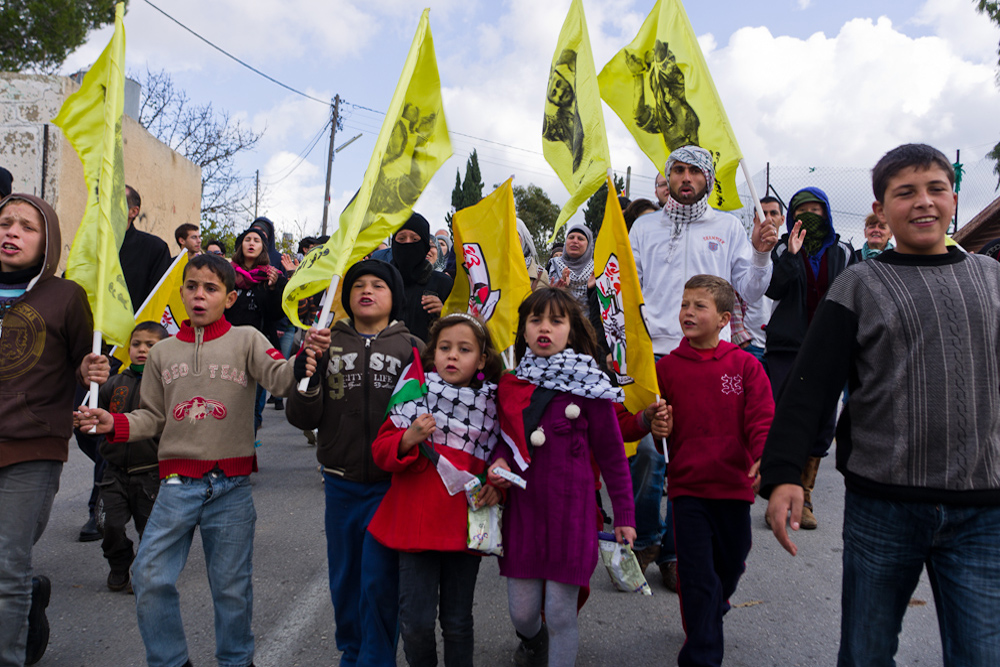
![]() Protesters hold pictures of Palestinian prisoner Hana al-Shalabi, on hunger strike for three weeks [EPA] | |||
Ramallah, West Bank - It began with Khader Adnan's sudden and bold declaration: "My dignity is more important than my life." And with that he refused food for the next 66 days. With each day he persisted, more and more people around the world were riveted to this man's brave confrontation of Israel's draconian policy of administrative detention. But perhaps more significantly, Palestinians from all political parties - as well as no political party - united and rallied together in support of this man and against Israel's unfair treatment of Palestinian prisoners. Now, Hana al-Shalabi approaches the completion of her third week on hunger strike. Like Adnan, Shalabi, 29, is protesting administrative detention, torture and humiliation at the hands of Israeli soldiers. These individuals represent not just the 300 Palestinians currently in administrative detention, or the over 5,000 Palestinians still in Israeli prisons. They exemplify and speak for all Palestinians in a way that no politician or political party has been able to do for a long time. The authorities of the West Bank and Gaza Strip have been simultaneously vying for power while nominally trying to "reconcile" the occupied land's divisions. Meanwhile, Adnan and Shalabi have galvanised Palestinian support across party lines. "She really makes me want to join the revolution again," said one young man, a former fighter in the Al-Aqsa Brigade, who is now working for the Palestinian Authority's security forces. Shalabi began her strike as soon as she was detained by Israeli forces on February 16. She was already well-acquainted with the cruelty of administrative detention, which allows Israel to hold Palestinians indefinitely without charge or evidence. Shalabi had recently spent over two years under that status and was released last October in the prisoner swap deal between Hamas and Israel. The PA's ability to convince the population of its legitimacy is at an all-time low. Contrary to the fantasies spun about the West Bank's prosperity, people in Palestine are destitute. The cost of living has never been higher: gas, electricity and food prices have skyrocketed, and food insecurity among the population is estimated at 40 per cent. On top of that, a cash-strapped government - with over $1bn in debt and unfulfilled loans - is speaking of raising taxes and slashing more services. The dissatisfaction with the PA's performance has ignited protests in all West Bank cities and prompted even some Fatah supporters to speak of it being time to dissolve the PA. In Gaza, the state of affairs is even grimmer, due to the six-year siege imposed on the coastal enclave. An acute power crisis threatens a "collapse of essential services". Hospitals are close to running out of the necessary power to operate, the amount of available drinking water has dropped by 60 per cent and food prices are surging. Over the past six months, PA President Mahmoud Abbas and the Hamas government have had their moments of glory. President Abbas generated short-lived exhilaration when he took his bid for statehood to the United Nations last September and Hamas was highly praised when it secured the release of over 1,000 Palestinian prisoners released in exchange for Israeli corporal-turned-sergeant Gilad Shalit. But these political manoeuvres are intended and only serve to defend politicians' positions and spheres of power in the midst of an internecine conflict over control, rather than mobilise a national resistance movement. In the meantime, Israel has quietly escalated its colonisation and tightened its control over occupied Palestinian territories. In February alone, 380 Palestinians were arrested, 158 individuals were displaced and 825 olive trees were uprooted by Israeli forces. Those numbers do not even speak to the significant uptick in vandalism and attacks by settlers and the deaths and injuries suffered by Gazans from continued aerial bombardments. The status quo in Palestine is becoming less bearable for more people and the current leadership has proven unable or unwilling to challenge it. But then again, Israel is not the only power at risk of losing its relevance. As Mourad Jadallah, a legal researcher with Addameer, a prisoners' rights organisation in Ramallah, told Asa Winstanly in an interview: "Why did the Palestinian media and the Palestinian Authority ignore Khader Adnan and his hunger strike? Because he's [affiliated with] Islamic Jihad? Or because he's taking the memory back to the days when the prisoners were leading the national resistance?" Khader Adnan and Hana al Shalabi have reinvigorated resistance and raised the long-flagging morale of people on the streets. This is a dramatic testament to the adage that change can only come from below - so maybe it's time we stop looking to the top. Charlotte Silver is a journalist based in the West Bank, Palestine. She is Editor at The Palestine Monitor and a graduate of Stanford University. The views expressed in this article are the author's own and do not necessarily reflect Al Jazeera's editorial policy. from Al Jazeera |
Labels:
Abbas,
Grace Paley,
Hana al-Shalabi,
hunger strike,
Khader Adnan,
Palestine
Saturday, February 25, 2012
Friday, December 30, 2011
Jules and Helen Rabin's Weekly Vigil
With War Over, Staging A Final Vigil
Saturday, 12/24/11 9:30am
LISTEN (3:37)
MP3 | Download MP3 - Vermont Public Radio

VPR/John Dillon
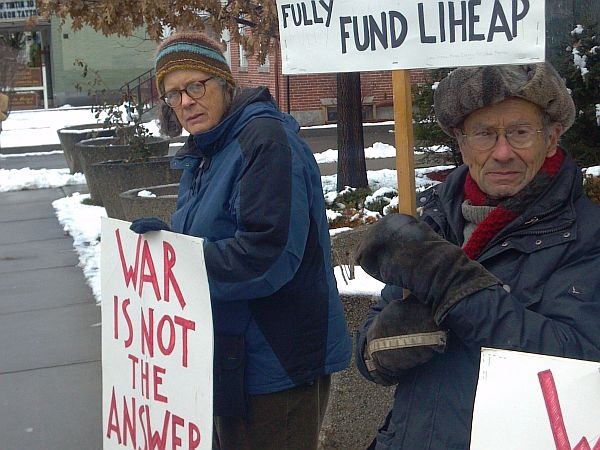
Helen and Jules Rabin have occupied this sidewalk weekly in Montpelier in vigil for the Iraq War. They say they will hang up their signs at the end of the year.
But as VPR's John Dillon reports, other activists say they'll continue to stage demonstrations until all U.S. soldiers come home from Afghanistan and other conflicts.
(Dillon) For nine years, veteran peace activists Jules and Helen Rabin have held a midday Friday vigil in front of the Montpelier post office.
They usually arrive around noon, unpack their signs, and stand with a half-dozen others as the lunchtime crowd streams by. A few offer silent nods, others look away or say some harsh words. And some, like Anne Sarcka, give a hug of gratitude as they walk past.
(Sarcka) "You are something else. Thank you for being out here all these years."
(Dillon) Jules Rabin is 87, a short, spry man with an expressive face and a ready smile. Before he hoists his sign, he stuffs disposable hand warmers inside his large leather gloves.
(Rabin) "I chill easily. And we've gone through a couple of boxes, big boxes of these."
(Dillon) Rabin says he feels the wind and chill more these days, so with the withdrawal of U-S troops from Iraq he's ending this form of outdoor activism.
(Rabin) "We've been doing this for nine years. And Helen and I been here just - with a few exceptions - just about every week for nine years. But we're getting cold and we're getting tired."
(Dillon) Rabin is a baker, well known for his sourdough bread, a former college professor, and a life-long peace activist. He protested the Vietnam War and in the early 1960s, Rabin took part in an 8,000 mile disarmament march across North America and Europe.
He says his Montpelier vigil is just one small part of a movement this year that has swept from Arab capitals to Wall Street.
(Rabin) "People are learning that it's not enough to vote every two or four years. You vote with your feet and you vote with a sign you make yourself when the spirit moves you. Something terrible is happening in the country then you express yourself. And that's a citizens vote, too."
(Dillon) Rabin has a new sign today. It says: "One war is over, now use defense spending to keep people warm."
It refers to federal cuts to a program that helps low income people heat their homes.
Helen Rabin says one goal of their weekly vigil was simply to remind the public what their government was doing around the world.
(Helen Rabin) "I feel like the destruction of Iraq, the social fabric of Iraq hasn't been in the forefront of people minds. And we were concerned about that. It's been mainly that, it's not like we feel like we could stop the war. It's just to keep the issue in front of people".
(Dillon) While the Rabins plan to hang up their signs others will maintain the weekly vigil.
Dave Connor is associate pastor at the Old Meeting House in East Montpelier.
(Connor) "We're happy that the war is officially ended in Iraq but we should probably be paying reparations right way for what we've done and left in Iraq behind us. We want to bring the troops home from Afghanistan. We support the troops in every way but we think the safest and best place for them is outside of Afghanistanand back home doing National Guard work in this country."
(Dillon) Connor says the Rabins are an inspiration for their enduring dedication to promoting peace.
Monday, December 19, 2011
A Man of Flesh & Cardboard: a play about Bradley Manning
Politics and Protest in Papier-Mâché Heads
By DANIEL M. GOLD
Published: December 12, 2011
Peter Schumann’s Bread and Puppet company, a staple of the Off Off Broadway calendar for 40 years, is a refreshing reminder of the vitality and power of street theater. Part carnival, part protest, all pageant, Bread and Puppet productions express political outrage and satire, sometimes coarse and raw.
Lee Wexler/Images for Innovation
Bread and Puppet Theater is presenting "Attica," a 1971 piece, at the Theater for the New City.
Using outsize papier-mâché heads and intricate masks and costumes, the shows offer a funhouse-mirror reality. Narration is barked through a megaphone, and words are usually secondary to the music: loud beats of a drum, cymbal or gong, backing Mr. Schumann’s screechy violin and razzy kazoo. Plots are mostly sketchy, but images nestle firmly in memory. There isn’t a lot of nuance in a cartoon.
Now at the Theater for the New City, the company, based in Glover, Vt., is offering a program of two works. (It is also presenting a separate show for young audiences called “Man = Carrot Circus.”) The first, “Attica,” revives a piece Mr. Schumann first created in the weeks following the notorious 1971 riot at that prison and its aftermath; a giant-headed governor is undisturbed by the bloody resolution he orders, while a “gentleman angel” hovers over a prisoner’s corpse.
A new work, “Man of Flesh & Cardboard,” is an extended howl at the treatment of Bradley Manning, the Army private now imprisoned for more than 18 months on charges that he provided government files, including a video of an American helicopter attack in Baghdad, to WikiLeaks. (On Friday, a day before Private Manning’s 24th birthday, he will have his first public hearing: the military equivalent of a grand jury will be convened to determine whether prosecutors may proceed with his court-martial.)
Much is inscrutable in “Man of Flesh & Cardboard,” which presumes a great deal about the case. At times two women portray a Private Manning and a Soldier Manning. News organizations — embodied as an old, compliant woman — are indicted for being credulous and complicit with the military. At one point, figures clad in black pirouette with their arms extended, like the posed prisoner in Abu Ghraib; at another, cardboard skeletons share a dance of death.
Now in his 70s, Mr. Schumann shows that he remains urgently invested in the politics of the age. In introductory comments to the audience, he calls Private Manning a prisoner “for having committed the crime of exposing war crimes.”
Sunday, December 11, 2011
When a non-violent protest ends in death
Nabi Saleh, a small village of about 550 people, 20 km northwest of Ramallahin the West Bank, has been organising non-violent protests against land theft since 2009. On December 9, 2011, the Friday demonstration began as it always did: villagers, international and Israeli activists gathered in the centre of the village and marched towards land usurped by the Israeli settlement of Halamish. Soon after, the Israeli military drove to the entrance of the village in jeeps and began firing teargas at the protesters. Mustafa Tamimi, 28, was protesting with other young men from the village. As the jeeps stopped to let a bulldozer clear rocks that had been placed in the road to prevent their entrance, Tamimi and a few others moved closer to throw stones in a symbolic gesture against occupation.An Israeli soldier opened his door, aimed his gun and shot Tamimi directly in the face with an "extended range" teargas canister; he was shot from a distance of less than 10 metres, according to witnesses. Tamimi died from his injuries. Some experts trace conflict in the area back to 1976, when the illegal Israeli settlement of Halamish (or Neveh Tzuf) was established on land belonging to Nabi Saleh. Since then, the settlement has continued to grow and expand. In 2008, residents of the village challenged the construction of a fence by Israeli settlers on private Palestinian land. When the case was brought to Israeli court, it was decided that the fence must be removed. However, like many Israeli court rulings on Palestinian grievances, it was not upheld "on the ground" and the settlement continued to illegally annex Palestinian land. Soon after, settlers seized control of several springs which were all located on land belonging to Nabi Saleh residents. Today, around 13 per cent of the villagers has been arrested by Israeli authorities for participating in the demonstrations - including 29 children and four women. Recently, two prominent leaders of the non-violent struggle, Naji Tamimi and Bassem Tamimi, were arrested and remain prisoners in Israel. They are charged with "incitement" and organising "illegal" demonstrations.
| ||||||||||||||||||||||||||||
Labels:
Bassem Tamimi,
Lazar Simeonov,
Nabi Saleh,
Naji Tamimi,
Palestine,
Ramallah
Tuesday, December 6, 2011
Howard Zinn Puppet Show at SUNY New Paltz
The Red Wing Blackbird Theater presents a short "mic check" show prior to a Noam Chomsky lecture.
Subscribe to:
Posts (Atom)