Sunday, January 5, 2014

African Asylum Seekers Protest in Telaviv January 5, 2014


In an unprecedented protest, some 20,000 African asylum seekers march to Rabin Square to demand that Israel examine their asylum claims and stop arresting and detaining members of the refugee community.
Asylum seekers demonstrate in Tel Aviv’s Rabin Square on the first day of a three-day strike protesting detentions and demanding refugee status, January 5, 2014. (Photo: Activestills.org)
Around 20,000 asylum seekers, mostly from Eritrea, assembled in Tel Aviv’s Rabin Square Sunday morning to demand recognition as refugees. Across Israel, asylum seekers went on a three-day strike, and more protests were planned.
In recent weeks, the government stepped up the arrest and imprisonment of African asylum seekers who entered the state without permits. Several months ago, Israel’s High Court of Justice struck down a law authorizing the state to lock up for three years any person who entered the country illegally, and in some cases, indefinitely. But last month the Knesset passed a new law, authorizing the state to hold asylum seekers in prison for a year. A new “open” holding facility named “Holot” began operating in the desert, where asylum seekers can be held indefinitely until their eventual deportation.
In recent weeks and months the government has stepped up enforcement measures against Israeli businesses that employ asylum seekers and municipalities have been shutting down shops and restaurants owned by Africans, adding to a feeling of despair in the asylum seeker community.
The general strike is the latest step in the African protest campaign against the recent measures. Dozens of asylum seekers walked out of the Holot facility (most of them were returned by force), large marches took place in Tel Aviv and Eritrean dissidents broke into an event in the North hosted by the Eritrean ambassador to Israel. Some 50 people were injured and arrested in the fight that broke out between the regime supporters and the protesters.
Most asylum seekers who do work are employed in hotels and restaurants, mostly as various types of cleaners.
Protesters in Tel Aviv held signs reading: “We are not criminals; we are refugees,” and “Freedom”. Speakers told stories about the plight of the community. “We are living in fear,” one speaker said, “the government waged war on us.” At least a couple members of Knesset showed up and expressed their support for the asylum seekers.
Speaking at the rally, chair of the Knesset Committee on Foreign Workers MK Michal Rozin (Meretz) said, “this is an existing moment: tens of thousands of innocent people are not willing to go to prison, standing together and shouting: ‘we are not criminals.”
“There are certain steps (taken by the state) about which we cannot stay silent,” she continued. “It’s time for real answers – and the government can give them.”
There are some 53,000 African Asylum seekers in Israel. The government refuses to review their individual requests for refugee status and instead refers to them as “infiltrators.” The term, which was used to describe Palestinians refugees that tried to enter the country in the 1950s, is also commonly used in the Hebrew media.
A man holds an Eritrean flag as asylum seekers protest continued detentions and demand Israel examine their asylum claims, January 5, 2014. (Photo: Activestills.org)
Asylum seeker women march toward Tel Aviv’s Rabin Square on the first day of a three-day strike demanding refugee rights in Israel, January 5, 2013. (Photo: Activestills.org)
African asylum seekers hold signs demanding health care and protection at a rally in Tel Aviv’s Rabin Square, January 5, 2014. (Photo: Activestills.org)

Wednesday, January 1, 2014

"Resist so Life May Exist!"


KANSAS CITY, MO. Defense attorney Henry Stoever meekly approached the bench of Presiding Judge Ardie Bland Dec. 13, complaining that security had refused to let him bring certain pieces of evidence into the courthouse: a full-sized wooden door with a banner proclaiming, "Open the door to a nuclear weapons free world!", as well as an array of picket signs. Stoever was representing eight nuclear protesters on this unlucky trial date, and Bland, who had sentenced other nuclear activists to jail just two years prior, was the inauspicious icing on the cake.

Bland's eyebrows rose at Stoever's odd request and the packed courthouse tensed for the inevitable ridicule. "Well, I permit it!" Bland said. With that statement, Bland set the tone for the next three hours, as protest songs, jokes about national security and even the elderly reveries of Oblate Fr. Carl Kabat, 80, and Franciscan Fr. Jerome Zawada, 76, were permitted in the Kansas City municipal courtroom.

 The eight activists were pleading not guilty to charges of trespassing onto the relocated National Nuclear Security Administration's Kansas City Plant July 13. Since 1949, the plant has produced or acquired "about 85 percent of the components that go into a typical nuclear weapon," according to the Government Accountability Office.

It took a year to move the nearly 3 million-square-foot facility 8 miles, and the relocation alone cost $80 million, according to a plant press release. On July 13, around 80 people gathered outside the plant's new location, including priests, sisters, Catholic Workers and local activists. They came to protest nuclear weapons stockpiling, as well as the environmental destruction and exorbitant cost of the plant's relocation. Twenty-four people were arrested after they walked through a full-sized wooden door (the same door that Stoever ultimately hefted into the courtroom) and onto plant property.

 William Birkner, the plant's lieutenant of protective forces, was prosecutor Kendrea White's only witness. When White asked him to explain why he called in the arrest, Birkner pointed to the door that was leaning against the wall near the witness stand. "They actually went through this door and crossed onto the property after they held a prayer session," Birkner testified.

 During Birkner's cross-examination, Stoever received permission from Bland to play a 10-minute video of the July 13 protest. Stoever's laptop was connected to a large, flat-screen television, and as the video began, the courtroom was assailed with Louis Armstrong loudly singing: "I'm gonna lay down my sword and shield/Down by the riverside/Ain't gonna study war no more."

 People in the gallery glanced at one another in surprise, and when Bland did not tell Stoever to turn off the video, the courtroom filled with whispers, and then outright laughter. In the video, protesters held signs and banners outside of the Kansas City Plant amid dozens of security officers. Armstrong faded out, his voice replaced by the activists' singing and drumming, including a raucous song led by the gruff voice of Kabat.

 This time, Bland laughed. Jane Stoever, organizer of the protest and wife of Henry Stoever, was the first to take the witness stand for the defense. Her husband's first question was about the door. Bland smiled as Jane meticulously explained how the door was made. "We got the door from the Habitat for Humanity thrift store, and the Catholic Workers helped make a stand for the door, and the banner was made from my mother's old clothes ..." "Your honor, I'm not sure of the relevance of the door," objected White, cutting off Jane's ruminations.

 Jane appeared unfazed, and she apologized to Bland for leaving the door's original banner at home. Stoever continued to ask his wife a multitude of questions, and Jane responded by musing over the history of nuclear weapons and her decades of activism against them.

At one point, as Jane explained the Non-Proliferation Treaty, Stoever pulled a copy of the U.S. Constitution out of his pocket. He couldn't find what Jane was referring to, so Catholic Worker Brian Terrell, husband of one of the defendants, called out from the gallery, "Henry! It's Article VI!" When it was White's turn, she appeared visibly annoyed and immediately asked Jane why she thought getting arrested was more effective than running for City Council.

 This question made the gallery, most of them activists themselves, laugh heartily. Kabat, who has spent more than 18 years in prison for civil resistance to nuclear weapons, took the stand. He began talking about his years as a missionary in the Philippines and Brazil, and Bland eventually cut him off with the request, "Can you please try and get to this decade?"

 Kabat responded, "Well, I celebrated July 4th out there," in reference to his solitary action at the plant in 2012, in which he cut the perimeter fence in order to let in "all of the Holy One's deer and other animals that once used the former bean field for its habitat." Stoever tried to bring up the 1980 Plowshares action in which Kabat also caused "minor damage" to nuclear nose cones, but Kabat interrupted him to say, "I'm sorry, but it wasn't minor damage."

 The courtroom erupted with laughter, yet Kabat seemed confounded. He later told NCR that he had arranged to represent himself, so he couldn't understand why Stoever wouldn't just let him talk. White fixated on one question for Kabat. "Don't you teach your parishioners to obey the rules?" "God's rules," Kabat responded. "Aren't those rules the same as the law?" "Well, I went to school in Mississippi [pre-civil rights] ..."

 The prosecutor, a black woman, interrupted: "OK, let me rephrase the question. Should you obey rules?" "If they are wrong, we should disobey them!" Kabat yelled out, and many people in the gallery audibly agreed. "We each have our own conscience to follow," he continued. "If there was a gas chamber across the street, I would say that we should all go right now and destroy it!" "So you would tell everyone to trespass on private property?" "You betcha, if it's a gas chamber!" "But is it OK to disobey the law?"

 "It was absolutely right for Rosa Parks not to get up and move to the back of the bus." In exasperation, White asked, "Are you the one deciding the rules?" "Well, yes," responded Kabat. "I have my own conscience and I'm 80 years old." White seemed to visibly give up at this point -- slumping over her notes and facing a wall for the remainder of the trial. She also refused to cross-examine any of the remaining four defendants, including Zawada. "You're not a Johnny-come-lately," Stoever said to Zawada. "In 1988, you came before federal Judge Joseph Stevens three times for resisting the Minuteman II missiles in Missouri."

 "Not correct," Zawada replied. "Five times." When Zawada later said, "We must transform our preoccupation with nuclear weapons. ... We need to become people of conscience," he asked him, "You mean by causing destruction to missile silos?" "I would want to propose alternatives to them," Zawada explained. "I just wanted to know if I was going to see you again in a few weeks," Bland said mischievously.

 "If you're inviting me, I'll come," Zawada answered, to more laughter. After listening to Stoever's impassioned closing argument, Bland invited the eight defendants to approach the bench. Offhandedly, he pronounced them guilty of trespassing. "I volunteered to take this case because I've done this before with Mr. Stoever and I find it interesting," Bland said, in reference to the activists he sentenced to jail two years ago. "If you're not getting to anyone else, you're getting to me. I think you're educating, because every time I learn something."

 The gallery murmured their approval, and the defendants nodded. "I want to do something a little different," Bland continued. "I want to say, I totally understand the argument made about Rosa Parks. I've done a significant amount of research on the civil rights movement, and they all suffered the consequences. ... However, I think the more significant thing is that the world was changed by their actions. I can sit here before you, as a black man, doing justice." Then Bland announced the sentence, shocking the courtroom. "I want each one of you to write a one-page, single-spaced essay on each of the following six topics," Bland said. "Your responses will be attached to the court record, which is a public record. They will exist as long as Kansas City exists. My way will give you a chance to say what you want to say." (See sidebar below.) The defendants were not given a printed copy of the essay questions. It appeared that Bland had come up with the questions during the trial. The courtroom erupted in applause and cheers, and the court clerk said in laughter, "I know you're all excited, but the judge is still on the bench!"

 After the trial, people lined up to shake hands with Bland. NCR asked Kabat, who has been sentenced countless times, what he thought about the unusual punishment. "I will not promise anything, sign anything, pay anything," Kabat said. Then he paused, musing, "I will probably write something." A sentence of six essay questions The following are six questions posed on the spot by Presiding Judge Ardie Bland in the Dec. 13 trial against eight nuclear protesters charged with trespassing onto the Kansas City Plant.

Bland found the defendants guilty of the crime, but instead of jail or community service, he sentenced the group to writing a one-page, single-spaced answer to each of the questions.
 1. If North Korea, China or one of the Middle Eastern countries dropped a nuclear bomb on a U.S. city tomorrow, would that change your opinion about nuclear weapons?

 2. If Germany or Japan had used nuclear weapons first in World War II, do you think that would have changed your opinion?

 3. What would you say to those who say, "If we [the U.S.] do not have the big stick, that is, if we get rid of our nuclear weapons, and other countries develop nuclear weapons, then we do not have the opportunity to fight back"?

 4. You defendants say you are Christians and one is a Buddhist. Fr. [Carl] Kabat says that you should disobey ungodly laws. How do you respond to someone who believes there is no God? Who is to say what God believes, for example, when Christians used God to justify slavery and the Crusades?

 5. How do you respond to those who have a God different from you when they argue that their religion is to crush others into dust? 6. Who determines what "God's law" is, given the history of the USA and the world? -- Compiled from notes taken in the courtroom by NCR and defense attorney Henry Stoever Thanks for your support in 2013. Happy New Year!

Tuesday, December 17, 2013

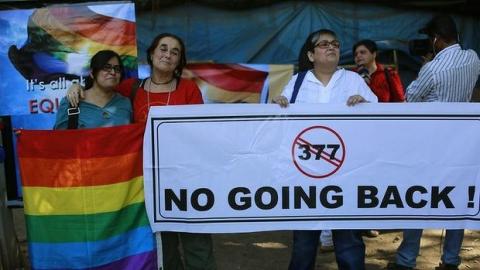
Indian LGBT Activists Outraged as Supreme Court Reinstates Gay Sex Ban

Jason Burke   The Guardian   December 11, 2013
A group of Indian activists hold a banner against section 377 of the Indian Penal Code that criminalises homosexuality during a protest in Mumbai.
AP
First there was surprise, then shock, then anger. By nightfall thousands across India had taken to the streets in spontaneous protests against an unexpected supreme court decision on Wednesday reversing a judgment that had decriminalised gay sex in the country.
Activists had expected the court simply to rubber-stamp the original 2009 ruling. Now India will rejoin the more than 70 countries – mainly in Africa, the Middle East and south Asia – where homosexual relations are illegal.
The reinstatement of a 153-year-old law passed under British rule and based on 16th-century English legislation means "carnal intercourse" between consenting adults of the same sex is once more defined as "unnatural" and punishable by up to 10 years in jail.
Waving multicoloured flags and wearing black bandanas, the crowd of protesters that gathered at the Jantar Mantar, a favourite point for demonstrations in the Indian capital, Delhi, was full of young men and women.
"I am gay, punish me," read one banner. "My love is not a crime," read another. The crowd cheered slogans of "My body, my rights" shouted by transgender protesters wearing bright traditional clothing.
For many the predominant emotion was disappointment. The 2009 decision of the high court in Delhi to repeal the law banning gay sex, known as section 377, was seen as a landmark in the campaign for equality in India.
"I was so disheartened by this judgment. It was supposed to be a first in a series of rights for the LGBT in India: property rights, marriage rights and so on," said Raja Bagga, a 25-year-old lawyer. "It would have been a precursor to a better, dignified life."
Few expected the legal challenge launched by conservatives – including Muslim and Christian religious associations, a rightwing politician and a retired government official turned astrologist – to succeed. The supreme court is known for its broadly progressive judgments that often order politicians or officials to respect the rights of the poor, disadvantaged or marginalised communities.
"It's a tremendous blow. It's unprecedented for a court with a long history of expanding rights to reduce dignity, not protect it," said Gautham Bhan, a prominent gay activist.
Among the supporters of the challenge was Baba Ramdev, a Hindu holy man with a mass following who has fought a long legal battle to maintain the ban on gay sex.
At a press conference following the judgment, Ramdev invited the gay community to his yoga ashram where he said he would "cure them of homosexuality", which he described as "unnatural, uncivilised, immoral, irreligious and abnormal". He said he would do so by "keeping them in a room with a heterosexual for a few days".
Tanuja Thakur, a Hindu spiritual leader, told the Guardian: "When two people of same sex indulge in a physical activity, it goes against nature. And anything unnatural is criminal in nature."
He said homosexuality was "happening because society is not doing enough spiritual practice".
The fierce debate – at least among metropolitan elites – prompted by Wednesday's judgment demonstrates how sexual relations have become a battleground in India, often revealing cultural splits between generations, between urban and rural dwellers and between those who invoke a "traditional past" contaminated by western influences and those who stress a local history of pluralism and tolerance.
Few now expect the beleaguered government, led by the Congress party, to risk limited political capital and sparse energy on a fight forgay rights.
The opposition Bharatiya Janata party, a Hindu nationalist party, has won a series of recent victories in state elections at the expense of the traditionally liberal, secular Congress, and though Indian society is changing very rapidly it remains profoundly conservative. The home minister, Sushil Kumar Shinde, said it was "not possible to legislate on anything now".
Gay rights activists say the community faces significant discrimination and police harassment, even if prosecutions for same-sex activity have been rare. Criminalising homosexuality makes them vulnerable to blackmail, they say.
Defenders of the supreme court decision said the objections of the judges to the repeal of section 377 were "constitutional and legal, not moral".
However, critics said that the wording of the judgment – which refers to the "so-called rights of LGBT persons", describes same-sex relations as "against the order of nature" and says that "lesbians, gays, bisexuals or transgenders constitute only a miniscule fraction of the country's population" – reveals deep prejudice.
Gay activists say there is increasing support for their cause. Only about a dozen people attended India's first gay pride march, in the eastern city of Kolkata in 1999.
Now thousands gather there each year and similar events are held in Delhi, Mumbai, Bengaluru and other cities. Gay film festivals and university campus groups have also sprung up. "This is not the same community as 10 years ago. This is a real call to arms," said Bhan.
Vikram Seth, the Indian prize-winning novelist, said he was hopeful. "Today is a great day for prejudice and inhumanity and a bad day for law and love. But law develops and love is resilient and prejudice will be beaten back," he told the NDTV news channel.
"I wasn't a criminal yesterday but I'm certainly a criminal today … But I do not propose to take the permission of their lordships when deciding who to love and who to make love with."

Saturday, November 9, 2013

Protest shuts down Sixth Street


November 08, 2013 7:00 pm  •  
RACINE — Twelve Racine women effectively closed a block of Sixth Street for an hour Friday afternoon after they sat in the middle of the street in front of U.S. Rep. Paul Ryan’s office, 216 Sixth St., to push him to take action on immigration reform.
Police blocked off the street at Main Street and allowed the women to address a crowd of several dozen that gathered in front of the Racine office for Ryan, the Janesville Republican who represents Racine County in Congress.
The women-led protest, organized by the Milwaukee-based immigrant rights group Voces de la Frontera, called on Ryan to work for speedy immigration reform and stop deportations.
Police wrote down each woman’s information and told them that they would be cited for the incident, according to Joe Shansky, a representative of the organization.
One of the women, 77-year-old Racine resident Luz Maria Hernández, said some of her children have been waiting in Mexico for 17 years for their visas to be approved.
“I have no fear because I’m fighting for my children and for many families who also suffer and are saddened,” said Hernández, who has nine children, 31 grandchildren and nine great-grandchildren.
Hernández, her one daughter who has been able to move to Racine, 57-year-old Sofia Anguiano, and her granddaughter Cecilia Anguiano were three of the women cited during the protest.
Hernández and her granddaughter were arrested together in a protest in Washington, D.C., in September, but Sofia Anguiano said that Friday was the first time she has ever been ticketed in the United States.
Another protester, Luisa Morales, 25, said that deportations are of particular concern for her because she was raised in Racine by two parents who were always at risk of being deported.
“I feared everyday in my childhood because they came to this country undocumented,” she said. “I had to grow up much sooner than most kids.”
Shansky said that the organization has held similar protests in front of the offices of Ryan, Gov. Scott Walker and Sen. Ron Johnson in the past to spur action on immigration reform.
The protest began at about 3 p.m. and lasted for about an hour, until the women concluded the protest and willingly moved out of the street.

Monday, November 4, 2013

Charlotte Bunch pays tribute to Sunila Abeysekera (1952-2013)


Charlotte Bunch pays tribute to Sunila Abeysekera (1952-2013), a courageous feminist and human rights advocate within Sri Lanka, and a leader in South Asia and globally.
Sunila at the World Social Forum, Porto Alegre 2005. Credit: Susanna George
The world lost an extraordinary, brave and articulate voice for human rights when Sunila Abeysekera (1952-2013) lost her battle with cancer on September 9th in Colombo. For many of us, we lost one of our most trusted and beloved friends and feminist thinkers who was a beacon of insight and commitment always prodding us to examine a different angle on an issue, learn from another movement or book, devise a new strategy, and never give up.  She also had a playful relish for life - its joys as well as its contradictions - with a love for the arts and popular culture, for pistachio ice cream and string hoppers as well as for politics and gossip.  Even amid the difficulties of a defender’s life, she snatched time to watch the latest movies and read voraciously – discarding used pot-boilers in airports and pondering post-modern feminist theory to discuss in our “free time”. She gave birth to two children on different continents, and adopted several more as the need arose,  incorporating them seamlessly into what her daughter Subha hailed at her funeral as her “unconventional” life of activism and love.
A courageous feminist and human rights advocate within Sri Lanka, Sunila was also a leader in South Asia and globally. She was at the forefront on many issues, fighting relentlessly for justice and human rights on behalf of all who experienced discrimination and persecution, whether on the basis of their politics, race-ethnicity, nationality or culture, class, gender or sexual orientation.  Sunila embodied both an intersectional analysis and the connection between the local and the global. Deeply grounded in her national context, she also participated in international movements, and walked the halls of the UN in Geneva and New York on behalf of all her causes.
A singer and actress by training, Sunila began her work as a Human Rights Defender in the mid 1970’s in a nonpartisan interethnic organization protecting leaders in her country’s youth movement. She become a key figure in numerous Sri Lankan civil society groups over the ensuing decades - as a founder of the Women and Media Collective, as an advocate for women workers in the free-Trade Zones and the tea plantations, and then in support of the Mothers Front and Women for Peace that stood up against state repression in her country’s long and deadly ethnic conflict.  
In 1990, as violent repression and terrorism in Sri Lanka increased, she assumed  leadership of INFORM Human Rights Documentation Centre. Over the next two decades, she worked across deep ethnic divides in seeking accountability for human rights violations by all sides in the war and demanding a negotiated political solution.  Like her father, Charles Abeysekera who died in 1998, she became a leading voice for human rights in her country and in her work at the UN.
While her island was always home, Sunila had an abiding curiosity about the world and  traveled widely. She spent a high school year in California as an exchange student where she developed a vast knowledge of US popular culture and folk music, which she often sang. She studied “women and development” at the Institute for Social Studies in The Hague in 1977, where she moved into an apartment with a Jamaican and a Peruvian instead of sticking with her national group. In 1994, she worked in Peru with Centro de la Mujer Peruana Flora Tristan as part of a feminist South-South exchange program. She lived several times in The Hague and in Kuala Lumpur when she needed to escape her homeland. She traveled endlessly for events everywhere, including the World Social Forums where she helped organize Feminist Dialogues.
Sunila and Lala Huarou, China 1995. Credit: Fatima Jaffer
I met Sunila when we were both exploring feminist connections globally at the 1985 NGO Forum held with the UN World Conference on Women in Nairobi. The following year, I traveled to India and Sri Lanka with Roxanna Carrillo – her Peruvian roommate and now my life partner - as part of a cross-cultural feminist team that experienced the intensity of her work and the dynamism of South Asian feminism first hand. 
Our long friendship was forged during the Global Campaign for Women’s Human Rights in the 1990’s that sought recognition of women’s rights as human rights at the UN World Conferences in Vienna, Cairo, and Beijing and advocated for gender analysis at the World Conference on Racism in Durban in 2001.  With her knowledge of the UN Human Rights system and her experience in mainstream human rights movements, Sunila taught  us much about this work in her gentle and uncomplicated way. Her presence has been crucial to bringing feminist analysis to human rights work in many areas such as peace and security, refugees, and sexual rights to name only a few.    
Sunila also knew the movement had to be multi-generational and sought to keep up with new ideas and younger women. She was a resource person in leadership institutes at the Center for Women’s Global Leadership at Rutgers, as well in our joint institutes with the network of Women Living Under Muslim Laws (WLUML) in Istanbul and Lagos.  She was a frequent presence at many leadership workshops and activities held in the Asian region; her generosity with her time and knowledge is noted by many groups throughout the world who have held tributes to her.  
One of Sunila’s major contributions over the last decade was building awareness of and support for women’s human rights defenders. As a defender and feminist who lived with threats to her life and in exile, she led with great authenticity and could bring feminist and human rights organizations together.  She spearheaded the first International Consultation held on this subject in Colombo in 2005, and guided the work of the Women’s Human Rights Defenders International Coalition, an advocacy network that formed out of that meeting.  She also served as chair of the Board of the Urgent Action Fund that supports women activists in crisis. 
Sunila at an Urgent Action Board meeting in 2007
November 29th was declared International Day for Women Human Rights Defenders at the end of the 2005 Consultation on that date.  This is part of the16 Days of Activism Against Gender Based Violence Campaign (Nov. 25-Dec 10), and in 2013, we will honour Sunila and other defenders who have died this past year.  
In this 20th anniversary year since the Vienna Human Rights Conference in 1993, the loss of Sunila is particularly poignant. We miss her profoundly, but the impact of her work and vision lives on in the many women and men who she touched and her spirit will accompany us forever.
Read Sunila writing on openDemocracy 50.50,  A brutal manifestation of patriarchy and Challengung ourselves at Beijing+15
To read a collection of memories of Sunila go to www.Sunilaabeysekera.com  and further tributes at AWID:  Remembering Sunila: A tribute to the life and work of Sunila Abeysekera

Monday, October 14, 2013

Monday, September 23, 2013

Pictures from the Bread and Puppet Museum by Karen Ranucci

Elka Schumann runs the print shop of Bread and Puppet, printing banners, posters
and small books.
The Bread and Puppet Farm was owned by the Dopp Family. Daisy Dopp was
a writer for the local paper, doing a column on farm life.

Wednesday, September 4, 2013

The Women of Fukushima


Over a year since three reactors went into meltdown at the Fukushima Daiichi Nuclear Power Plant, a broad, disparate anti-nuclear movement is growing in Japan. Nowhere is that more apparent, perhaps, than in Fukushima prefecture, where a group of local women boldly protest the deafening silence of the Japanese government over the worst nuclear accident of this century. Largely ignored by their own media, these brave women brush aside their cultural shyness and share their brutally honest views on the state of the cleanup, the cover-ups, the untruths and the stagnant political climate in today’s Japan. Supported with rare footage from inside the exclusion zone, as well as from abandoned neighboring towns, the Women of Fukushima (“Fukushima no Onnatachi”) offers startlingly candid insights, in the women’s own voices, about what has become of their lives, homes, and families in the aftermath of 3/11. 

福島第一原子力発電所で3基の原子炉がメルトダウンを起こしてから1年以上。さまざまな人々による大がかりな反原発運動が日本国内で拡大しつつあります。この運動がもっとも顕著なのは、おそらく福島県でしょう。そこでは地元の女性グループが勇敢にも立ち上がり、今世紀最悪の原発事故に対する日本政府の沈黙に抗議しているのです。国内メディアにほとんど無視されてきたこの勇敢な女性たちは、内気な県民性を脇へ押しやり、現在の日本における汚染除去の現状や隠ぺい、嘘、そして停滞した政治情勢について包み隠さぬ率直な意見を公表しています。立ち入り禁止区域内や周辺の荒れ果てた無人の村々の貴重な映像と共に、「福島の女たち」は3・11によって彼女たちの人生、故郷、家族がどのような影響を受けたのかについての驚くほど率直な見解を、彼女たち自身の声で伝えます。


Women of Fukushima-English subtitles from Paul Johannessen on Vimeo.

Tuesday, August 27, 2013

VERMONT YANKEE TO CLOSE FINALLY!!!!


Some lines from an interview with Grace... speaking about
how the affinity group from Vermont Yankee demos came
to Washington to support those who were arrested during
the Women's Pentagon Action.

Monday, August 26, 2013

Washerwoman Concert in the Bread and Puppet Museum


The Washerwomen were created in the 1980s for a show about resistance to war and as a tribute to Grace Paley.


Photo by Charles Steckler

From an essay by John Bell "Grace Paley's Political Arts:
Text and Ritual Performance in the
Women's Pentagon Action (excerpt) 2009