A blog to celebrate this amazing woman with records of non-violent actions around the world to further her vision of resistance to empires of war and exploitation.
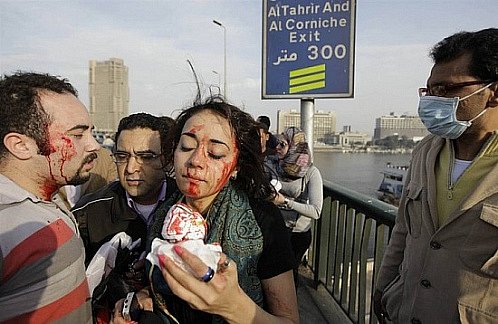
http://www.sawtalniswa.com/2011/02/women-of-the-egyptian-revolution/This is a homage to all those women out there fighting on the streets of Egypt, to those whose voices and faces were hidden from the public eye during the first days of the revolution! The album by now has traveled the world back and forth via online social networks, blogs and websites.Patience and modesty are highly appreciated.
First and foremost the credit for this album goes to the courageous people of Egypt who are teaching us that freedom is taken and not given.
Second, to the women who by their courage, determination and strength are inspiring millions of us around the world.
Third to the photographers who took these photos and especially to those who have caused absolutely no problems when it came to copyright issues.
Fourth, to the amazing web of people who have been sending me photos and captions for the album, and to those who are sending corrections of mistakingly posted or labeled photos.
This compilation is meant to further shed the light on the Egyptian people´s strife for freedom, and the complicity of the world governments with the Mubarak regime. It is meant as a call for action and active solidarity with the Egyptian people. A call to protest companies like Vodafone and Orange/France Telecom who have left the Egyptian people incommunicado in the face of a brutal and a repressive regime. The world governments and big corporations have ignored the voices of millions of Egyptians, and the voices of millions of us worldwide and continue to further support and whitewash the crimes of the dictatorship, both vocally and silently.
This album is just a small reminder of what is happening right now, as you are reading this, on the streets of Egypt. A hint of the grassroots and popular revolution facing up to around 41 years of a totalitarian regime, a dictatorship and emergency laws (around 11 years under Sadat, and around 30 years under Mubarak)
It is also very important to highlight the first spark of it all, the Tunisian revolution and its women. To stress that we should not shift our attention from them. They are still fighting and the battle is not over yet. Here is a link to a photo-stream from Le Monde / France in total admiration of the inspiring and courageous women of Tunisia http://ow.ly/3MDyZ
It is important to note that I did NOT TAKE ANY of these photos and that neither I nor Sawt Al-Niswa have the rights to any of them. For any commercial usage we suggest getting in contact with the people who have the rights to them, agencies and photographers.
I´m trying to confirm that all the photos I´m receiving are from Egypt and that they were taken during the past week´s rebellion. It is not an easy task judging the amount of photos I´m receiving and the limited resources I have. If you identify any photo that is mistakingly posted here, or that is not from Egypt or from the ongoing revolution please don´t hesitate to contact me.
For photographers and agencies (a.k.a. Copyright information and the other excruciating reality)
As much as I don´t support nor agree with copyright, I know I´m legally bound to credit you for these photos and take permission to use them. But I hope you understand that the importance of giving visibility to the women in the Egyptian revolution comes before your commercial “rights”. And that this album is NOT being used in any commercial way (i.e. no one is making money out of your work, not a dime) But nevertheless, I´m trying to include the sources of all the photos in a way to acknowledge the work of the photographers and as a thread to who has the copyright for them (in case of agencies). If you see any of your photos here, and wish to be credited for it, please contact me with a clear reference to the photo and the corresponding credits. If your photo was mistakingly credited to someone else, I apologize, contact me and I will fix it.
For the last several years, a group of young Afghani’s in the Bamyan province of Afghanistan have been on “Our Journey To Smile” (http://ourjourneytosmile.com/blog/). This journey to smile is their effort to bring about peaceful nonviolent solutions to conflicts in Afghanistan using the principles taught by Jesus, Gandhi, Martin Luther King, Jr. and others.
Who We Are
Who we are-
Afghan college students and youth who started this journey in 2008.
International volunteer for Journey to smile
International volunteeers who will participate in support of Our Journey to Smile.
To date, we have volunteeers from Singapore, Egypt, Italy and Nepal.
VENUE World Heritage Bamiyan Buddhas
LOCATION Bamiyan Afghanistan DATE 21 September 2009
Our Journey to Smile in 2009 wishes to gather Afghan college students and Afghan youth from every ethnicity, as well as international volunteers from every country, to come together at the World Heritage Bamiyan Buddhas in Afghanistan on International Peace Day, 21st September 2009, to be an example and encouragement to the world that wide-scale humane relations based on a humane love is possible, however in-humane our current global situation may be.
So, we ask every one of you, to join or support Our Journey to Smile, knowing that the cumulative hope and conscience of humanity, once communally expressed on a wide enough scale, would demonstrate a love that inspires Mankind to grow and to be compassionately humane.
In 2009 AD, Afghanistan is in the depth of world conflict and self-interest.
Whatever our fellow humans, Obama or Osama or others, decide, the college students and youth of Afghanistan, together with all of humanity, wish to to encourage ourselves and others to SMILE.
By smiling, we are grieving over Mankind’s proud, in-humane and self-absorbed behavior. We seek to raise the possibility of a humane love by building wide scale humane relationships and thus enjoy the growth of a majority public practice of humanity’s shared hopes.
We hope to put courage and dignity into our lives and our world, to put delight into the hearts of children and all of Mankind, to suggest that whatever our shared condition, a HUMANE LOVE is possible.
While the US, NATO, Taliban and all other players decide what to do with a country that is not theirs and with a world that does not belong only to them, is there ANY ONE PERSON who understands what the common, average citizen of Afghanistan or citizen of the world wishes for?
Some say realistically but sadly, ‘this Journey will NOT happen….’
What they are saying is ,’ Genuine love, humanity and peace belong only to the poets and the fables. Humanity doesn’t have what it takes.’
It’s sad because both Afghans and the world need encouragement.
It’s sad because reality, perhaps life itself, seems keen for us to remain frozen in the timid beliefs that humanity cannot have the HUMANE RELATIONS which the majority of us want, that the small minority of decision-makers must always have their self-interested ways.
We want to address our own cynicism, to try, to face disappointment, to take our small steps, believing that when we embark on Our Journey to Smile, humanity has to grow and will not shrink back to its unsure and undignified days.
Afghan Youth Peace Volunteer’s Journey To Smile Bringing the Reality of the War In Afghanistan to the United States
For the last several years, a group of young Afghani’s in the Bamyan province of Afghanistan have been on “Our Journey To Smile” (http://ourjourneytosmile.com/blog/). This journey to smile is their effort to bring about peaceful nonviolent solutions to conflicts in Afghanistan using the principles taught by Jesus, Gandhi, Martin Luther King, Jr. and others.
These brave young Afghani men (and women) are aided by a humanitarian medical doctor from Singapore, Hakim, who previously worked for a Christian based NGO in Afghanistan, in the universal quest to promote nonviolence in a region that has been racked by almost constant violence since the 1970’s. Douglas Mackey, from the FOR affiliate in the Olympia, WA area has been working with this group for well over one year.
Christian Peace Witness and other organizations have joined the effort to bring a few of the Afghan Youth Peace Volunteers to the United States this summer to share their story and their journey for nonviolence. Unfortunately, their request for Visa’s has been denied by the United States government on the basis that the U.S. government feels that they are risks to over stay their visas and not return to Afghanistan.
While attempts are still being made to get them Visa’s, there are still plans being made for a “virtual” tour of the United States for the Afghan Youth Peace Volunteers this summer if the Visa’s are not obtained in a timely manner. This virtual tour would consist of Josh Steiber, a young Iraq war veteran who became a Conscientious Objector, and others touring the U.S. and showing powerful films made by the Afghan youth, to various U.S. audiences and linking live to some of the Afghan youth so U.S. citizens attending these events have the opportunity to interact directly with these brave Afghan Youths who are working for non-violence.
Please go to “Our Journey to Smile” site (http://ourjourneytosmile.com/blog/) to learn more about these young Afghani’s and view some of their videos. Also consider doing one or more of the following:
Contacting your Congress person, Senator, the State Department or White House and ask them to provide Visa’s for these young Afghani’s to come to the United States either this summer (or sometime else in the near future);
Considering hosting Josh and his traveling partners for an event to talk with the Afghani Youth from Afghanistan (or possibly another country they may visit this summer if the U.S. government continues to deny their VISA request).
If the tour does not come by to your geographical area, consider hosting a live interaction from your area during a time that the Afghan Youth Peace Volunteers will be speaking to another group in this country where Josh Steiber will be. Your group would be able to ask questions and speak to the Afghan Youth and the other U.S. location live.
Consider helping to pay for this effort. Fellowship of Reconciliation is collecting donations for Christian Peace Witness for this event. Online donations can be made through the FOR website (http://www.forusa.org/) or checks can be mailed to FOR noting that the donation is for helping to fund the visit of the Afghan Youth Peace Fellowship to the United States (either physically or virtually).
Also, please pray for an end to United States military involvement in Afghanistan and for the success of the Afghan Youth Peace Volunteers in their journey to smile.
From Mazin Qumsiyeh I have spent 26 Christmases in our homeland but never had a more meaningful one than this one. In the traditional 12 days of the holiday season, we finished with class work at Bethlehem University. My masters' students and my undergraduate students did very well throughout the semester as they evolved their critical thinking and analytical skills and developed admirable self-confidence. Then the holidays came and with them came people from around the world to join in our struggle for freedom. In particular 73 French activists joined with others to attend and participate in a number of direct actions that challenge the colonial structure. Starting on 22-23 December in Jerusalem, the group participated in direct action and other events in Shaikh Jarrah, Silwan, and ethnically cleansed villages behind the green line. After two nights in Jerusalem focusing on the increased pressures to isolate and destroy life for the remaining inhabitants of this Palestinian city, the activists were to come to Al-Walaja village (a village that suffers from colonial settlement activities on the small percentage of its land that remains after Israel took over 75%). The Israeli apartheid army tried in vain to prevent the event from happening from preventing a bus company from transporting activists to blocking the road to the village to threatening people in the village. Strong will and creative on-the-spot triumphed maneuvers frustrated the army's maneuver and all did in through other means to hold a huge demonstration of at least 200 people (Palestinians and Internationals including some Israelis). Not allowing empty buses to come to pick the demonstrators, we still managed to get everyone out safely to go the manger square for the traditional Christmas procession. With over 50 volunteers wearing bright yellow vests (Handala and Free Palestine prominently printed on them), we distributed over 2000 'Christmas Cards' to the Christian pilgrims. The cards referred to the wish for peace with justice and linked to the Kairos document, a call by Palestinian Christians issued a year ago (seehttp://www.kairospalestine.ps) Later in the afternoon, we traveled to Beit Jala where we shared putting-up a Christmas tree at the home of Abu Michel, a Christian whose land was taken over for the apartheid wall. Then onto Aida refugee camp for a meaningful Christmas Eve with refugees. Christmas day was spent mostly in Hebron old city including in a demonstration against the racist settlers who continue to attempt to destroy the old city. The occupation authorities used tear gas and stun grenades and kidnapped two internationals (French and a Scottish, both released later at night). Some Internationals joined us in the candle light march in the Shepherds' field that evening (over 2000 attended, a marvelous event; Above is a video of it http://www.youtube.com/watch?v=34HiwC75MCU). The next morning, activists went to Qalandia checkpoint and protested the Israeli army preventing Palestinians from entering Jerusalem. A Palestinian and nine French activists were detained and many were beaten and injured (video here: http://www.youtube.com/watch?v=VCpB54gcvUc). That afternoon, a tree planting event near the wall in Bil'in was met with Israeli tear gas and stun grenades (video herehttp://www.youtube.com/watch?v=L6uqb9ZuuCY). Later in the evening, we had an evening of camaraderie and solidarity despite attempts to politicize the event by some. The next day, the delegation visited Nablus (see photos at http://www.europalestine.com/spip.php?article5724) and on the way back stopped by Beitil and had a demonstration against the closure of roads inside the west bank to Palestinian travel (photos at http://www.europalestine.com/spip.php?article5721). Two were detained and several injuries were reported due to the Israeli assault on the peaceful demonstration. All detained in these various demonstrations were mistreated but were eventually released. I urge all to come visit us and see what is happening in the "little town of Bethlehem": 170,000 people nearly half of them are refugees crowded into 13% of the original district size of Bethlehem and surrounded by 27 ft high walls and electrified fences. Many people describe it as a Ghetto or a Bantustan (and the Israeli government calls such remaining Palestinian areas in the Negev and elsewhere as concentration areas). But on the positive side, the pressure of the occupation and the test of us make us better human beings. The hundreds of internationals that participated in these activities told us how honored and leased they were by having shared a meaningful holiday season with us. Energized, we now planned much bigger activities for this summer (stay tuned). Similarly, the Palestinians who participated in the demonstrations or who even simply hosted internationals in their homes or who even saw us on TV or read about us in newspapers all felt a sense of hope and empowerment. For me personally, having a house full of internationals sleeping everywhere eating together, working together, being attacked by occupation authorities together was the best Christmas gift. Come to think of it, that is what the message of that prince of peace born over two millennia years ago was about. We are the descendents of those first believing Shepherds who saw the star and believed in Jesus. Jesus born in a country called Palestine was thus Palestinian by birth but when he grew up he also challenged a Jewish ruler (Herod) put in place by a Western government. History does repeat itself although with some variation but the message of love and peace will eventually triumph. This Christmas from here din the Shepherds' field just down the hill from the Church of Nativity, we sang "this in my heart, I do believe.we shall overcome someday" .. Merry Christmas. by Mazin Qumsiyeh
Videos and other stuff from the action at the White House. To be clear, the organizers had no expectation of stopping the wars, changing government policy or even influencing public opinion. What we wanted was to keep the spirit of resistance alive and well, empower and encourage solidarity, which we did - and we had a good time doing it, arrests non-withstanding. Read Chris Hedges superb article for more on that.
By SARAH WHEATON Published: December 13, 2010 U.S. NEWS http://mobile.nytimes.com/article?a=713691&f=21 The prison protest has entered the wireless age. Inmates in at least seven Georgia prisons have used contraband cellphones to coordinate a nonviolent strike this weekend, saying they want better living conditions and to be paid for work they do in the prisons. Inmates said they would not perform chores, work for the Corrections Department's industrial arm or shop at prison commissaries until a list of demands are addressed, including compensation for their work, more educational opportunities, better food and sentencing rules changes. The protest began Thursday, but inmates said that organizers had spent months building a web of disparate factions and gangs - groups not known to cooperate - into a unified coalition using text messaging and word of mouth. Officials at the Georgia Department of Corrections said Monday that four facilities remain in a lockdown status and there have been no major incidents or issues reported. Inmates complained of scattered clashes with guards. Smuggled cellphones have been commonplace in prisons for years; Charles Manson was caught with one in a California penitentiary this month. Officials worry that inmates will use them to issue orders to accomplices on the outside or to plan escape attempts. But the Georgia protest appears to be the first use of the technology to orchestrate a grass-roots movement behind bars. Reached on their cellphones inside several prisons, six participants in the strike described a feat of social networking more reminiscent of Capitol Hill vote-whipping than jailhouse rebellion. Conditions at the state prisons have been in decline, the inmates said. But "they took the cigarettes away in August or September, and a bunch of us just got to talking, and that was a big factor," said Mike, an inmate at the Smith State Prison in Downing who declined to give his full name. The organizers set a date for the start and, using contact numbers from time spent at other prisons or connections from the outside, began sending text messages to inmates known to hold sway." Anybody that has some sort of dictatorship or leadership amongst the crowds," said Mike, one of several prisoners who contacted The New York Times to publicize their strike. "We have to come together and set aside all differences, whites, blacks, those of us that are affiliated in gangs." Now, Mike said, every dormitory at participating prisons has at least one point man with a phone who can keep the other inmates in the loop. Miguel, another prisoner at Smith who also declined to give his full name, estimated that about 10 percent of all inmates had phones." We text very frequently," he said. "We try and keep up with what's going on in the news and what's going on at other facilities. Those are our voices." They are also a source of profit to the people providing the contraband. Miguel said he paid $400 for a phone that would have cost $20 on the street. Mike said he bought his through a guard. "That's how a lot of us get our phones," Mike said. Inmates said guards had started confiscating the phones, and they complained that hot water and heat had been turned off. The Corrections Department placed several of the facilities where inmates planned to strike under indefinite lockdown on Thursday, according to local news reports. "We're hearing in the news they're putting it down as we're starting a riot, so they locked all the prison down," said an inmate at Hays State Prison in Trion who refused to give his name. But, he said, "We locked ourselves down." The inmates contend that if they have a source of income in the prison and better educational opportunities to prepare them for release, violence and recidivism will go down. But the Department of Corrections has not publicly acknowledged the protest. Mike said that the leaders were focused on telling inmates to remain patient, and not to consider resorting to violence. The inmates' closest adviser outside prison walls is Elaine Brown, a longtime advocate for prisoners whose son is incarcerated at Macon State Prison, one of the other major protest sites. A former Black Panther leader who is based in Oakland, Calif., Ms. Brown helped distill the inmate complaints into a list of demands. She held a conference call on Sunday evening to develop a strategy with various groups, including the Georgia chapter of the National Association for the Advancement of Colored People and the Nation of Islam. _______________________________________________
It's the birthday of writer Grace Paley, (books by this author) born in the Bronx (1922). Her parents were Jewish Socialist immigrants from Ukraine, Isaac and Manya Gutseit (which they changed to Goodside). They spoke Yiddish and Russian at home, and English in public; her father learned English by reading Dickens. Her family was affectionate and noisy — they loved to sing and to argue about politics. Young Grace absorbed different immigrant languages in the streets of the Bronx, and she loved listening to the gossip of family and friends and neighbors. She said: "The word gossip, which is considered so terrible, is really just another way of storytelling. And it's the way women tell stories, and it's kind of denigrated, 'cause its women who do it." And she said, "It is the responsibility of the poet to listen to gossip and pass it on in the way storytellers decant the story of life."
After high school, she took a class on English literature from W.H. Auden, who was her hero. During a lecture, he asked if there were any poets in the class who would like to meet with him and discuss their work. Out of 250 people, only five raised their hands, including Grace. She arranged to meet with Auden, and after an initial setback because she went to the wrong café, she did meet him and he read her poems, which she had written in his style, using British phrases and formal language. She said: "You understand I was a Bronx kid. We went through a few poems, and he kept asking me, do you really talk like that? And I kept saying, Oh yeah, well, sometimes. That was the great thing I learned from Auden: that you'd better talk your own language. Then I asked him what young writers now ask me — and I always tell them this story — I said to Auden, Well, do you think I should keep writing? He laughed and then became very solemn. If you're a writer, he said, you'll keep writing no matter what. That's not a question a writer should ask."
So she kept on writing poems, but she had plenty of other things in her life — she did occasional work as a typist, she was active in community projects, and she took care of her two young children. She had moved to Greenwich Village when she got married, and she spent many afternoons in Washington Square Park, hanging out with other mothers, hearing their stories. She would write down poems on scraps of paper, but she was too busy to think of writing anything much longer. Then she got sick, and she sent her kids to daycare so that she could recover. She had several days a week all to herself, so she started to write stories, drawing on the voices of the women she spent time with in the park every afternoon, writing about the kinds of events and characters that filled their lives.
She wrote three stories, and she showed them to a couple of people, including her friend Tibby McCormick, whose kids played with her kids. Tibby had just separated from her husband Kenneth McCormick, an editor at Doubleday, and Tibby guilt-tripped him into reading Paley's stories by telling him that their kids spent a lot of time hanging out at Paley's house and it was the least he could do. So he read them, and he came to see Paley and told that if she would write seven more stories, he would publish a book. And that was The Little Disturbances of Man (1959). Her first story in the collection, "Goodbye and Good Luck," begins: "I was popular in certain circles, says Aunt Rose. I wasn't no thinner then, only more stationary in the flesh. In time to come, Lillie, don't be surprised — change is a fact of God. From this no one is excused." The whole story had sprung from that single phrase, "I was popular in certain circles," which one of her aunts had said many years earlier. Paley said that she often based a story around a single line or phrase or way of speaking that rattled around in her head until she created a story for it.
She published just two more collections of stories, Enormous Changes at the Last Minute (1974) and Later the Same Day (1985). But she gained a devoted following, and when her Collected Stories was released in 1994, it was a finalist for the Pulitzer Prize and the National Book Award. She knew each story inside and out, and when someone would tell her that they loved one of her specific stories, her response was: "What's wrong with the rest?"
She never made her living as a writer alone. She taught at Sarah Lawrence and the City College of New York. And she was a passionate activist for social causes, protesting against nuclear proliferation and against wars from Vietnam to Iraq, and lobbying for women's rights. She said: "I think that any life that's interesting, lived, has a lot of pulls in it. It seems to me natural that I'd be pulled in those ways. [...] And you are privileged somehow to do as much as you can. I wouldn't give any of it up. And I've talked a lot about this with women's groups because I think that in whatever is gained, that everything, that the world should be gained. But that nothing should be given up. I think a good hard greed is the way to approach life."
She said: "You can't write without a lot of pressure. Sometimes the pressure comes from anger, which then changes into a pressure to write. It's not so much a matter of getting distance as simply a translation. I felt a lot of pressure writing some of those stories about women. Writers are lucky because when they're angry, the anger — by habit almost — I wouldn't say transcends but becomes an acute pressure to write, to tell. Some guy, he's angry, he wants to take a poke at someone — or he kicks a can, or sets fire to the house, or hits his wife, or the wife smacks the kid. Then again, it's not always violent. Some people go out and run for three hours. Some people go shopping. The pressure from anger is an energy that can be violent or useful or useless. Also the pressure doesn't have to be anger. It could be love. One could be overcome with feelings of lifetime love or justice. Why not?"
Nov 19. 2010
This Friday in Nabi Saleh the Israeli border police used its stink water
tank in the center of the village, as a clear and gross collective
punishment measure against the entire village for Friday demonstrations.
Nabi Saleh residents and demonstrators in the village center, where the
stink water was squirted.
The stink water is a foul-smelling liquid that makes it unbearable to
live in the place where it is squirted on for at least one week. It is
not officially intended for use inside a populated area, but that has
been its use against Nabi Saleh residents and demonstration in the past,
and this gross attack is now being retained.
The demonstration in Nabi Saleh against the creeping annexation of land
by the Halamish settlement started with an immediate unprovoked attack
by Israeli border police on a peaceful and non-violent march. Following
this attack, clashes erupted, with some stone-throwers attempting to
ward off the army incursion. Nevertheless the army manage to position
itself just outside the village`s built area and shot its tear gas
canisters towards the village, repressing also non-protesting civilians.
Throughout the demonstration the Israeli army has shot tear gas
canisters directly at the protesters, a dangerous conduct which violates
even the army`s own regulations. Rubber-coated still bullets were also
widely used by the army. As a result at least 10 protesters suffered
injuries.
Grace Paley's partner, Bob Nichols passed away this week. They had lived together in Thetford, Vermont for decades. He was 92 years old. Here is a clip, from several years ago, speaking about his concern for Washington Square, which he had helped to preserve in the sixties.
Nichols, a poet and novelist born in Worcester, Massachusetts, left home when he was young and became a landscape architect. He ... has published several volumes, including a collection of short stories published by the Johns Hopkins University Press, In the Air. Nichols’ other books includeSlow Newsreel of Man Riding Train,Address to the Smaller Animals,Red Shift, and numerous essays on economics and politics, among other subjects. A graduate of the Harvard School of Design, he described himself as an “activist and sometime organizer, involved in the anti-war, anti-nuclear and conservation movements." -from a Dartmouth College announcement.
Bob was a farmer, a poet, a playwright, a landscape architect and a community activist.
This winter there will be a staging of several of his short plays in New York City and hopefully this presentation will be repeated in Vermont in the early summer.
This is a tape that Liza Bear made with Bob Nichols about Washington Square.
This is alao by Liza Bear-- tape with Bob at a Grace Paley memorial.
Here is an article from 2006 in The Villager about Washington Square:
Square’s fountain to be moved; water jets will move musicians
Luther Harris, author of a definitive book on the history of Washington Square, displayed a large photo of Frederick Law Olmstead, the “father of American landscape design,” as he read his statement at the Art Commission. Harris said he was trying to emphasize that “Washington Square’s landscape is Olmstedian and that Parks is destroying it with its alien axial symmetry.”
Villager photo by Q. Sakamaki
By Lincoln Anderson
Folk singers strummed and warbled ballads against it. Local politicians - not one but four - testified against it. The Fine Arts Federation of New York stated it was opposed to the idea. Disabled advocates in wheelchairs angrily said they were being used as “pawns” - and not to do it in their name. And most of the people offering testimony during four hours of hearings on Monday said they didn't want the Washington Square Park fountain moved 22 feet to the east. But that didn't matter to the Art Commission, which voted to approve the shifting of the fountain, as well as the park's two statues, as part of the Parks Department's $16 million renovation project.
In doing do, they sealed the park's fate, meaning it will change from its historic Olmstedian design of curved pathways to a more formalistic, symmetrical Beaux Arts layout. And coming with the change to a more regimented look will probably be a parallel change in the use of the traditionally freewheeling park - though the Parks Department is avoiding saying that. Nine high-powered water jets in the fountain will make it hard to perform there.
After hearing the copious testimony, the commission took one hour to deliberate and vote on the three issues.
By votes of 10 yes and 1 no they approved moving the Giuseppe Garibaldi and Alexander Lyman Holley statues to the northern areas of the ovals they currently occupy on the park's central east-west pathway. Their vote on the fountain was unanimous. In his presentation of the plan, John Krawchuk, Parks director of historic preservation, said relocating the fountain would be a stunning improvement. Lining up fountain and arch would “enrich the view of the arch and invite people into the park,” he said. “It is a great civic gesture. Keeping the fountain hidden behind the arch is an intellectual nuance that will be seen as a missed opportunity by future generations.”
Just as at the numerous public meetings held before on the renovation, the overwhelming public sentiment at the Art Commission hearing was once again against the plan. State Senator Tom Duane testified against moving the fountain. Duane also said he supports keeping the fountain and sunken central plaza at their current elevation, though the latter was not within the purview of the Art Commission to decide, having been previously approved by the Landmarks Preservation Commission. Calling the fountain relocation “unnecessary,” Duane said, “While I understand the desire for symmetry between the fountain and the arch, Greenwich Village thrives precisely because its geography is not beholden to grids and symmetry. A park serving and representing our eccentric and eclectic neighborhood does not need perfect alignment.”
His remarks drew cheers and applause from the partisan crowd. Councilmember Alan Gerson deferred to the Art Commission on whether to move the fountain, noting this was part of the agreement he and Councilmember Christine Quinn crafted with the Parks Department in which Parks made commitments on other aspects of the renovation. Yet, Gerson added, “My personal view is that the fountain should stay where it's been my whole life. There's something discomfiting to me about having children in bathing suits playing in the fountain in the line of sight of one of our major arteries.”
Again, there were cheers. New Manhattan Borough President Scott Stringer and Assemblymember Deborah Glick also issued statements against moving the fountain. However, Kate Seely-Kirk, legislative aide to Quinn, the new Council speaker, read Quinn's statement, which, like Gerson, deferred to the Art Commission's judgment on moving the fountain. Except, Quinn didn't offer her personal view on the issue. “Boo!” hooted one woman in the audience. “Chris wimped!” Melissa Baldock, director of preservation from the Greenwich Village Society of Historic Preservation, read the society's statement in support of moving the fountain and statues.
“We see no reason to reject the location of these elements,” she said. A member of the opposition pointedly filmed Baldock with a handheld minicamera as she departed after testifying. Keen Berger, Greenwich Village Democratic district leader, noted her late husband Martin Berger 40 years ago defended the right of a mandolin player to perform in the park. Her voice rising to a shout, Berger implored, “The park is a living place - don't let them kill it!” However, weighing in in support of the move was Ric Bell, executive director of the American Institute of Architects, who called it the obvious thing to do. On the other hand, Tomas Rossant of the Fine Arts Federation of New York said the organization “opposes the relocation of the fountain and sees no reason why a progressive design can't be done with the fountain in place. This redesign privileges Beaux Arts axial symmetry over real history,” he said.
While the mayor appoints all 11 members of the Art Commission, a majority of the commissioners, seven, are selected from a list from the Fine Arts Federation of New York. Last year the federation wrote to the Art Commission expressing their objection to moving the fountain. Ronald Podolsky, attorney on a community lawsuit set to be filed once the project is ready to start, protested that he filed a Freedom of Information Law request to see the updated park redesign plan, but was only notified it was available for viewing the Friday before the hearing. “It is well known that straight lines are the lines of duty, curved lines are the lines of beauty,” Podolsky noted, knocking the redesign. However, broadening the debate, a speaker in support of the project, asked, “Straight lines don't make art? How about the Taj Mahal?” sparking some laughter. Sharon Woolums, a leader of the Emergency Coalition to Save Washington Square Park, on whose behalf Podolsky is filing the lawsuit, said the existing design from the community-driven renovation of the park led by Robert Nichols in 1969 shouldn't be changed. “Bob Nichols was also a theater director and understood how the fountain plaza would function as a theater,” Woolums said. “There is no need to change this brilliant plan. Do not destroy what works.”
Accompanying himself on guitar, Eric Levine, musical director of the Disabled in Action Singers, chose to sing his testimony: Adrian Benepe, our Park commissioner, Says stop the music and that they will do Let not a note by heard from neither man nor bird Ban the guitarists, they're Benepe's taboo We say no to Benepe's men Fight the good old fight again We are the surging mass We are worth more than grass The park's for all people - not just for N.Y.U. During a break in the testimony, Podolsky fittingly led some of the plan opponents in a round of Appalachian coal miners' songs about John L. Lewis. As testimony resumed, noting she's always been a Frisbee player, former City Councilmember Carol Greitzer said it's not a bad thing that there's lots of asphalt in the park. “To play Frisbee you need a lot of payment.
No one's mentioned that.” The actual use of the fountain once the park is renovated was a concern of the commissioners, most notably Byron Kim. Specifically, Kim and a few others voiced trepidations about the plan for a powerful 45-foot-high water plume and eight arcing side water jets in the fountain, wondering how this would mesh with the fountain's current use as a performance space for acrobats and musicians, or even merely as a place to sit and relax. Just the sound of this water display might discourage musicians from jamming nearby, Kim and some of his colleagues opined. They asked the Parks officials if any noise studies of the fountain had been done yet, to which Parks responded that they had not. “The splash factor,” Kim said. “Will it make it difficult for people to sit on the fountain? If you have a lot of water jets will people be able to hear each other talk?”
Art Commission member Otis Pratt Pearsall said the noisy fountain was “a huge issue that needs to be addressed.” Krawchuk said that musicians can ask a park attendant to adjust the fountain, controls for which will be located near the park house. “It'll all be digitized and electronic,” he assured. “I think that this will not be an issue for park users. Certainly, if we feel that noise is an issue, we can adjust the jets accordingly.”
He said the fountain would operate from April to November. Bill Castro, Manhattan borough Parks commissioner, said, in fact, most impromptu performances happen throughout the park, not in the fountain. Castro said time could be carved out for performances in the fountain when the water will be turned off. But larger performances will need to get permits, he said. The commission nixed the Parks plan to add a set of eight shiny pink granite urns atop the fountain's piers mirroring historic urns that were on the fountain before it was moved from 59th St. and Fifth Ave. to its present location around 1870.
The urns could be seen as a deterrent to the use of the fountain as an active performance space and could become large ornate ashtrays, commissioners said. The commission instead approved for the piers to be topped with new bluestone caps. There were issues with turning the Garibaldi statue to face southward. Parks said this would allow for better sunlight on the monument. However, a representative of the Garibaldi Museum said for the statute to face west showed how Garibaldi - Italy's equivalent of George Washington - was a man of both the Old and New World. But Amy Freitag, Parks director of capital planning, said by turning him south he would be looking at the historic Italian South Village. Where both statues are now is an impediment to people walking on the pathway, plus the Holley monument gets doused with dog urine since it's near the dog run, so it's best to move them, Parks said. These opened-up oval areas will also be improved as performance spaces, Parks officials said.
The use of the fountain for cooling off in hot weather and for a children's play area will also apparently come to an end with the renovation. The fountain was converted to a water-play feature for neighborhood children in 1934 with water jets spurting out of the eight fountain piers. The central fountain plume was installed in 1970. However, to meet the new code put in place after a drought a few years ago, in the renovation, the fountain's system will be changed to use recycled water, or water that keeps recirculating through it, as opposed to waste water, or water that goes down the drain into the sewer. Any fountain that uses more than 2,000 gallons of water a day must conform to the new code. The Washington Square fountain will use more than 2,000 gallons of water an hour, Parks Commissioner Adrian Benepe said.
As for use of the fountain by buskers and children, Freitag said, “Having people in the basin when it's dry is certainly something we'd like to explore. And we'll explore use of a [handicapped-accessible] temporary ramp [into the fountain]…. [But] our policy doesn't allow people to play in our fountains.” The restored fountain will continue to have three steps inside as it currently does. After the lengthy testimony, the commission first discussed and voted on the statues and urns. Signe Nielsen, a landscape architect member of the Art Commission, felt that since the fountain relocation had been the only thing the public had testified about, the commissioners were obligated to discuss it a bit. Alice Aycock, an artist member of the commission, said the fountain had always seemed “in no-man's land” to her: “It's neither here nor there. It's just uhhh.” Another commissioner said it was time for “a rebirth of the park” and a blotting out of any memory of how cars used to run through the park until they were banned in 1963. The plaza and north-south central pathway are roughly in the same spot where roads once ran through the park.
James Stuckey, a commissioner who said he plays 10 musical instruments, said the loss of the sunken plaza won't affect acoustics one bit. During discussion of the fact that a plaque to the Tisch family - who have given $2.5 million for the fountain's renovation - will be affixed to the new fountain, Aycock said perhaps another plaque should be added to acknowledge the famous musicians, like Bob Dylan, who got their start playing around the fountain - “so that it just not ignore that.” After the vote, ECO's Woolums angrily called it “a rubber stamp for the mayor's office. The Fine Arts Federation voted against it,” she noted. However, even the Fine Arts Federation's Roussant had predicted Parks would prevail. “There's too much behind this. Parks is really pushing for it,” he had said. Said Commissioner Benepe afterwards, “We're very pleased with the decision. Also, very happy with the fact that people care very deeply about parks. This was further evidence that New Yorkers care deeply about parks and are passionate about them.” The project should begin this spring or summer, he said. He said Parks will work on the issues of the water plume and jets. During her remarks one woman slammed New York University, accusing, “N.Y.U., which has kept a low profile in all this, is the main gainer, getting a symmetrical, clutter-free space for its graduation ceremonies. What a sorry fate that would be for this most individualistic spirited of parks.”
Yet, some of the project's opponents noted a significant absence at the hearing - no representative from New York University seemed to be present. N.Y.U. spokespersons did not return a call for comment by press time as to why the university did not present testimony or even appear to have an official at the hearing. This is a letter that Bob wrote in 2006 to The Villager:
To The Editor:
Re “Plaza size matters; judge extends order blocking Wash. Sq. project” (news article, May 24):
I was heartened by the news reported in The Villager two weeks ago of the community’s continuing resistance to the planned reconstruction of Washington Square Park. I haven’t kept up with the legal details or followed recent arguments as to the plaza’s size, but I have to smile at the purported cost of the dramatic deconstruction process, when the actual solution is really so simple and inexpensive. As I explained in The Villager before, the basic failure has been the refusal — perhaps recalcitrance or just plain ignorance — of Parks in maintaining the park. The present Parks Department is not altogether at fault.
The original design by the Committee of Architects in 1970 comprised a number of original elements, park furniture such as the circular benches at the corner entrances and some trees. These were nonstandard and required maintenance procedures unfamiliar to the Parks maintenance crew. They required special supervision and attention. We, the designers, and our sponsors, members of the Greenwich Village Community Association, did not see this as crucial. There was no watch committee to follow up on it or see that the engineering drawings and specifications were forwarded from the engineering firm to the Arsenal in case adjustments were needed.
An example are the trees in the raised sitting walls around the edge of the plaza. A crucial element, why have they not received the same attention to keep them healthy that they would have received on any college campus? The trees need nourishment, the soil needs water and air. It breaks my heart to see them. Years have gone by. While the political and legal battles continue, at the same time this might have been attended to. Nobody has thought to do such a simple thing. Or is it a question of calculated neglect?
The legal and bureaucratic answer is, of course: We have no money. No money for maintenance, only for capital improvement. And so, the park wrecked as $16 million “capital improvement.” Hilarious!
Robert Nichols,
Nichols was a member of the Greenwich Village Architects Committee
SYNOPSIS: In the opening moments of “Grace Paley: Collected Shorts,” Paley rhetorically asks an audience, “What is the responsibility of a poet?” We soon learn that Gracy Paley answered that question emphatically throughout her entire life.Lilly Rivlin’s inspiring film brings to life the momentous times in which this author and activist lived and worked as she reads from her short stories, poems and essays. Paley was a firebrand on the front line of protest. She opposed war and nuclear proliferation, and fought for the rights of women, which often landed her in jail. As a teacher she influences generations of writers. Grace Paley is a New York icon whose life attests to the possibility that one person can combine public responsibility with individual creativity. Paley not only broke the mold, she created a new approach to her life’s work that combined equal parts writer, activist, woman and mother.
In “Grace Paley: Collected Shorts” we learn the story of this child of Russian-Jewish immigrants, raised in New York City in the 1930s. We hear from her daughter, granddaughter and a wide range of fellow writers and activists. We also hear many of Grace Paley’s own words, the greatest joy of Rivlin’s revealing film. (David Becker)