Showing posts with label Palestine. Show all posts

Monday, October 24, 2016

For Peace in Palestine/Israel


200 women including Liberia’s Peace Laureate demand peace agreement on Israel’s Lebanese border / Cholo Brooks, GNN Liberia, 19/10/16

At the culmination of the two-week, cross-country march, Israeli and Palestinian women vow to continue their struggle until an agreement is reached.
Eetta Prince-Gibson Oct 20, 2016 3:56 PM
Women participating in the March of Hope dance at Qasr al-Yahud, October 19, 2016.Abbas Momani, AFP
Thousands finish women's peace march with plea for action at Netanyahu's door
From a celebration at the Dead Sea, to a march through the streets of Jerusalem, to a demonstration outside the Prime Minister’s residence, thousands of Israeli and Palestinian women Wednesday marked the conclusion of the March of Hope.
The march was organized and sponsored by Women Wage Peace, a non-partisan women’s group founded in 2014 in the aftermath of Operation Protective Edge in Gaza, which, according to its flyers, calls for an agreement that will be respectful, non-violent and accepted by both sides. “We will not stop until a political agreement, which will bring us, our children and grandchildren a safe future, is reached,” says their website. Organizers say the group is funded mainly by small donations from Israel and abroad, as well as by the Women Donors Network in the United States.
The cross-country March of Hope began on October 5, when some 2,500 women walked the first 5-kilometer segment from Rosh Hanikra on the Lebanese border to Achziv Beach, north of Nahariya. Every day since then, women have participated in 5 to 10 kilometer walks in different locales throughout the country, including one group that walked and biked in segments from Eilat to the area abutting the Gaza Strip.
Wednesday's events began at Qasr al-Yahud, the site where Jesus is believed to have been baptized by John the Baptist. Some 2,500 Jewish and Arab Israeli women arrived on buses from all over the country, from as far away as the Sea of Galilee and the Negev and Arava deserts. They were joined by more than 1,000 Palestinian women from the West Bank.

Monday, July 28, 2014

From Dissent: Dear Nick Kristof: Your Palestinian Gandhis are Already Here


Weekly protest in Bil'in, June 2011 (Anna Paq, courtesy of ActiveStills.org)
Writing on July 19 in a column intended to “correct a few common misconceptions” about the Israeli-Palestinian conflict, Nicholas Kristof perpetuated one of his own. Offering unsolicited advice to Palestinian political leaders, Mr. Kristof wrote: “If Palestinians turned to huge Gandhi-style nonviolence resistance campaigns [sic], videos would reverberate around the world and Palestine would achieve statehood and freedom.” Mr. Kristof’s sentiment is admirable. His glaring ignorance of ongoing Palestinian peaceful grassroots campaigns is not.
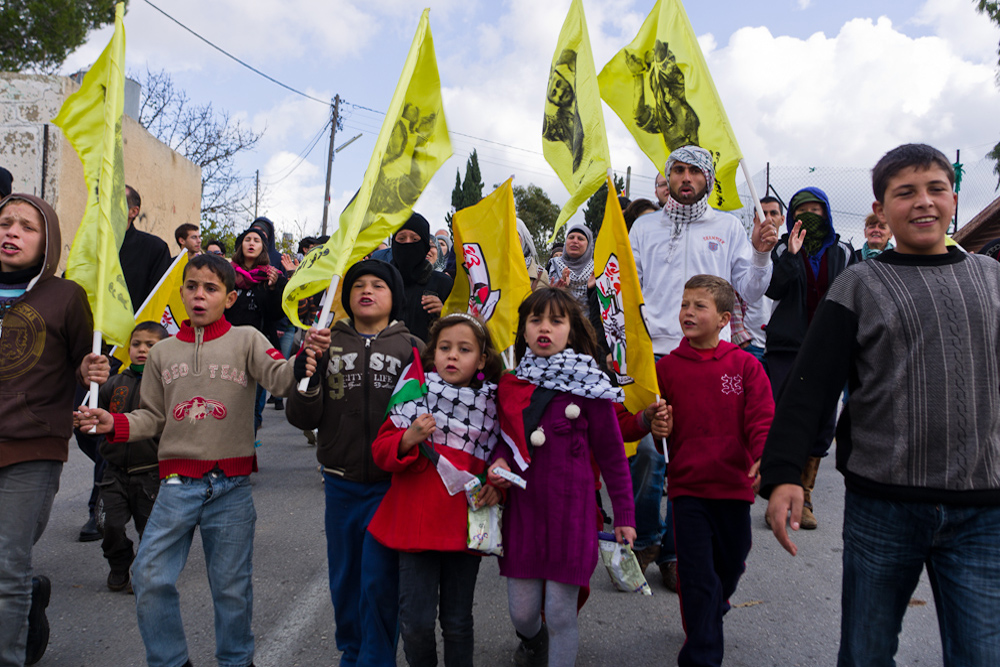
At a time of colossal regional violence, the growth of peaceful grassroots campaigns for Palestinian statehood and civil rights is one of the few uplifting stories in Israeli-Palestinian politics. Over the past decade, these campaigns have originated in communities with particular grievances, and slowly transformed into weekly marches for civil rights and statehood. In Bil’in, Palestinians have marched every Friday since February 2005, when community members first organized in defiance of the expropriation of half of the village’s farmland by the neighboring Modiin Illit settlement (the Israeli High Court returned one-half of the stolen land in 2007). Those demonstrations were featured in the Academy Award–nominated documentary 5 Broken Cameras, one of the few instances of global media attention on Palestinian peaceful protests. In Nabi Saleh, weekly marches have protested a similar expropriation of land, and the denial of basic civil rights by military rule. Other active villages include Budrus, Jayyous, Beit Surik, Biddo, Al-Wlajeh, Ni’lin, Ma’sara, Beit Ummar, and Iraq Burin, among others. Weekly demonstrations include anywhere from several dozen to several hundred protesters.
Weekly marches have not been the only Palestinian peaceful campaigns. Other methods include barricading roads on which Palestinians are not permitted to drive, mass prayer events, and hunger strikes. The Popular Struggle Coordination Committee serves as an umbrella organization for these efforts, coordinating “marches, strikes, demonstrations, direct actions and legal campaigns, as well as supporting boycott, divestment and sanctions,” according to its website. Some peaceful protesters have also worked with American and European counterparts to organize international demonstrators, such as a series of demonstrations on April 15, 2014, to protest use of U.S. tax funds to support the Israeli occupation.
The leaders who have emerged from these movements speak the Gandhian language of transformative nonviolence that Mr. Kristof implores them to employ. When I was in Bil’in last month, leading activist Iyad Burnat explained his philosophy of nonviolence to me: “I want my freedom, and I am not free if I harm another person.” Another activist in Bil’in, who preferred not to be named for fear of reprisal, told me: “If you want to visit my home, I do not care if you are Muslim, Jewish, or Christian. But you cannot bring violence with you, you cannot solve disputes with violence. That is our message to the Israelis who occupy us.”
While Mr. Kristof is wrong that Palestinians have yet to learn the value of peaceful grassroots campaigns, he is right that the Gandhi-like Palestinian movement is not “huge.” Why haven’t more Palestinians joined the movement? One theory is that Palestinians refuse to reject militancy. Another is that they fear the draconian violence visited upon peaceful protesters by the Israel Defense Force.
To understand why more Palestinians haven’t joined weekly peaceful protests, it’s important to consider something that Mr. Kristof likely overlooked in formulating his advice: Israeli Military Executive Order 101 outlaws political gatherings of more than ten Palestinians in the West Bank, meaning that Palestinian peaceful gatherings inherently amount to illegal civil disobedience. Unsurprisingly, the Israel Defense Forces responds to these protests with force as a matter of policy. Nearly every Friday in the Palestinian villages in which demonstrations occur, the IDF unleashes an occasionally lethal, always perilous, combination of tear gas, rubber-coated bullets, water cannon–fired “skunk” liquid, and—sometimes—live fire. Onestudy found that between 2004 and 2011, thirteen Palestinian civilians were killed in nonviolent demonstrations; Iyad Burnat, the Bil’in organizer, puts the overall figure at closer to forty.
The IDF also punishes villages known for nonviolent civil disobedience campaigns in other ways. Nonviolent demonstrators have been arrested and imprisoned for “incitement”; children can be detained and processed in the IDF’s notoriously gruesome military court system, whose treatment of children UNICEF has called “cruel, inhumane and degrading”; and permits for work in Israel can be revoked. The IDF has confirmed that it uses collective punishment against villages in which these protests occur. It turns out that there are substantial costs to even peaceful resistance against the state that controls your access to water, electricity, transportation, employment, and freedom of mobility. In this context, what seems remarkable is not that more Palestinians do not join the demonstrations, but that so many have persevered over the past decade.
These harsh IDF responses are not provoked by Palestinian violence. A leaked 2010 U.S. State Department memo records Israel’s top military official in the West Bank, General Avi Mizrahi, promising to use skunk water and mass arrests to quell “even demonstrations that appear peaceful.” As one senior Israeli military official told an American counterpart in 2011: “We don’t do Gandhi very well.”
While Israel’s response to Gandhi-style tactics has been utterly condemnable, Palestinians have certainly not perfected the tactic. Kristof writes that “too many Palestinians define nonviolence to include rockthrowing. No, that doesn’t cut it.” Mr. Kristof is right that occasional rock-throwing does occur, but he is thoroughly wrong to define and dismiss the movement by this practice. Stone-throwing is not employed as an organized strategy of demonstrators, who use marches and sit-ins to make their point; those who throw stones tend to act alone or in small groups, and often after the IDF initiates violence against peaceful demonstrators.
The relentless emphasis on stone-throwing cedes any sense of proportionality, ignoring the egregious violence with which the IDF crushes Palestinian demonstrations by official policy. As Iyad Tamimi, a leading organizer in Nabi Saleh, told me when I visited the village last month: “After one day of protest, we pick up 1,500 tear gas canisters. Are the Israelis nonviolent?”
To substantiate his claim about rock-throwing, Mr. Kristof turns not to a third-party report, but instead links to the official IDF blog. On that page, the IDF misleadingly boasts of “protecting the right of Palestinians to protest peacefully,” despite the fact that Israeli military law explicitly denies Palestinians the right to political demonstration.
Of course, it would be ideal for no rock-throwing to occur, just as it would be ideal for the IDF not to resort to violence in crushing popular demonstrations, just as it would be ideal, writ large, for the IDF to withdraw from the West Bank, which it occupies in contravention of international law. But demanding that Palestinians absorb the tremendous personal costs of nonviolent civil disobedience, then dismissing the promising movement because of marginal stone-throwing, all while ignoring the vast IDF violence against Palestinian civilians—this is not the empathy Mr. Kristof has offered to others struggling for human rights around the globe.
This brazen disproportionality is precisely why Mr. Kristof’s advice is so insulting. In the past decade, Palestinians living under a grinding military occupation have undertaken profound personal and community sacrifices to organize peaceful demonstrations for civil rights and statehood. Instead of empowering these courageous moderates by sharing their stories, Mr. Kristof turns a blind eye, dismissing the cost of their courage while arrogantly suggesting that he will pay attention when Palestinians learn to behave perfectly.
It’s this type of superficial media coverage that makes so preposterous Mr. Kristof’s prediction that “the resulting videos [of nonviolence resistance campaigns] would reverberate around the world and Palestine would achieve statehood and freedom.” Thevideos are here, here, here, and here, among other places, Mr. Kristof. Will you start sharingthem?

Sam Sussman co-directs Extend, an American start-up non-profit organization that offers five-day educational tours of the West Bank to young American Jews. He is an M.Phil. candidate in International Relations at Oxford. He tweets @SamSussman1.

Saturday, June 2, 2012

Interview with the Filmmakers of 5 Broken Cameras

The amazing film, 5 Broken Cameras tells the story of non-violent protests in Bil'in. This is an interview conducted by Liza Bear with the Palestinian and Israeli pair. It was a very difficult interview as the New Directors/New Films did not provide interview space for journalists, so the sound is not great.

Thursday, March 8, 2012

Palestinian Prisoner's Hunger Strikes


Protesters hold pictures of Palestinian prisoner Hana al-Shalabi, on hunger strike for three weeks [EPA]
Ramallah, West Bank - It began with Khader Adnan's sudden and bold declaration: 
"My dignity is more important than my life."
And with that he refused food for the next 66 days. With each day he persisted, 
more and more people around the world were riveted to this man's brave 
confrontation of Israel's draconian policy of administrative detention. But 
perhaps more significantly, Palestinians from all political parties - as well 
as no political party - united and rallied together in support of this man and 
against Israel's unfair treatment of Palestinian prisoners.
Now, Hana al-Shalabi approaches the completion of her third week on 
hunger strike. Like Adnan, Shalabi, 29, is protesting administrative detention, 
torture and humiliation at the hands of Israeli soldiers.


These individuals represent not just the 300 Palestinians currently in 
administrative detention, or the over 5,000 Palestinians still in Israeli prisons. 
They exemplify and speak for all Palestinians in a way that no politician or 
political party has been able to do for a long time.
The authorities of the West Bank and Gaza Strip have been simultaneously
 vying for power while nominally trying to "reconcile" the occupied land's 
divisions. Meanwhile, Adnan and Shalabi have galvanised Palestinian support 
across party lines.
"She really makes me want to join the revolution again," said one young man, 
a former fighter in the Al-Aqsa Brigade, who is now working for the Palestinian 
Authority's security forces.
Shalabi began her strike as soon as she was detained by Israeli forces on 
February 16. She was already well-acquainted with the cruelty of administrative 
detention, which allows Israel to hold Palestinians indefinitely without charge or 
evidence. Shalabi had recently spent over two years under that status and was
 released last October in the prisoner swap deal between Hamas and Israel.
The PA's ability to convince the population of its legitimacy is at an all-time low. 
Contrary to the fantasies spun about the West Bank's prosperity, people in 
Palestine are destitute. The cost of living has never been higher: gas, electricity 
and food prices have skyrocketed, and food insecurity among the population is 
estimated at 40 per cent.
On top of that, a cash-strapped government - with over $1bn in debt and unfulfilled 
loans - is speaking of raising taxes and slashing more services. The dissatisfaction 
with the PA's performance has ignited protests in all West Bank cities and prompted 
even some Fatah supporters to speak of it being time to dissolve the PA.
In Gaza, the state of affairs is even grimmer, due to the six-year siege imposed on 
the coastal enclave. An acute power crisis threatens a "collapse of essential 
services". Hospitals are close to running out of the necessary power to operate,
 the amount of available drinking water has dropped by 60 per cent and food prices 
are surging.
Over the past six months, PA President Mahmoud Abbas and the Hamas government 
have had their moments of glory. President Abbas generated short-lived exhilaration 
when he took his bid for statehood to the United Nations last September and Hamas 
was highly praised when it secured the release of over 1,000 Palestinian prisoners 
released in exchange for Israeli corporal-turned-sergeant Gilad Shalit.
But these political manoeuvres are intended and only serve to defend politicians' positions 
and spheres of power in the midst of an internecine conflict over control, rather than 
mobilise a national resistance movement.
In the meantime, Israel has quietly escalated its colonisation and tightened its control 
over occupied Palestinian territories. In February alone, 380 Palestinians were arrested, 
158 individuals were displaced and 825 olive trees were uprooted by Israeli forces. 
Those numbers do not even speak to the significant uptick in vandalism and attacks by 
settlers and the deaths and injuries suffered by Gazans from continued aerial bombardments.
The status quo in Palestine is becoming less bearable for more people and the current 
leadership has proven unable or unwilling to challenge it. But then again, Israel is not the 
only power at risk of losing its relevance.
As Mourad Jadallah, a legal researcher with Addameer, a prisoners' rights organisation in 
Ramallah, told Asa Winstanly in an interview: "Why did the Palestinian media and the 
Palestinian Authority ignore Khader Adnan and his hunger strike? Because he's 
[affiliated with] Islamic Jihad? Or because he's taking the memory back to the days when 
the prisoners were leading the national resistance?"
Khader Adnan and Hana al Shalabi have reinvigorated resistance and raised the long-flagging 
morale of people on the streets. This is a dramatic testament to the adage that change can 
only come from below - so maybe it's time we stop looking to the top.
Charlotte Silver is a journalist based in the West Bank, Palestine. 
She is Editor at The Palestine Monitor and a graduate of Stanford University.
The views expressed in this article are the author's own and do not necessarily 
reflect Al Jazeera's editorial policy.


from Al Jazeera

Sunday, December 11, 2011

When a non-violent protest ends in death


Nabi Saleh, a small village of about 550 people, 20 km northwest of Ramallah
in the West Bank, has been organising non-violent protests against land theft
since 2009. On December 9, 2011, the Friday demonstration began as it
always did: villagers, international and Israeli activists gathered in the centre of
the village and marched towards land usurped by the Israeli settlement of
Halamish. Soon after, the Israeli military drove to the entrance of the village
 in jeeps and began firing teargas at the protesters.

Mustafa Tamimi, 28, was protesting with other young men from the village. As
the jeeps stopped to let a bulldozer clear rocks that had been placed in the road
to prevent their entrance, Tamimi and a few others moved closer to throw stones
in a symbolic gesture against occupation.An Israeli soldier opened his door, aimed
his gun and shot Tamimi directly in the face with an "extended range" teargas
canister; he was shot from a distance of less than 10 metres, according to witnesses.
Tamimi died from his injuries.

Some experts trace conflict in the area back to 1976, when the illegal Israeli
settlement of Halamish (or Neveh Tzuf) was established on land belonging to
Nabi Saleh. Since then, the settlement has continued to grow and expand. In 2008,
residents of the village challenged the construction of a fence by Israeli settlers
on private Palestinian land. When the case was brought to Israeli court, it was
decided that the fence must be removed. However, like many Israeli court rulings
on Palestinian grievances, it was not upheld "on the ground" and the settlement
continued to illegally annex Palestinian land.

Soon after, settlers seized control of several springs which were all located on
land belonging to Nabi Saleh residents. Today, around 13 per cent of the villagers
has been arrested by Israeli authorities for participating in the demonstrations -
including 29 children and four women.

Recently, two prominent leaders of the non-violent struggle, Naji Tamimi and Bassem
Tamimi, were arrested and remain prisoners in Israel. They are charged with "incitement"
and organising "illegal" demonstrations.
fter Friday prayers, residents of Nabi Saleh, with international and Israeli activists, marched towards land stolen by an Israeli ettlement [credit: Lazar Simeonov]
A
Israeli soldiers arrived and blocked the road leading out of the village [credit: Lazar Simeonov]

Frank La Rue, UN Special Rapporteur on the right to freedom of opinion and expression, attended the demonstration [credit: Lazar Simeonov]

La Rue was welcomed to the village by a special, Palestinian-brand of modern art:  empty teargas grenades hanging from wires [credit: Lazar Simeonov]

The demonstration escalated when Israeli soldiers fired teargas at the protesters [credit: Lazar Simeonov]

With the illegal Halamish settlement in the background, Palestinian youth throw stones at Israeli soldiers [credit: Lazar Simeonov]

Some youth managed to throw some of the teargas canisters back at the Israeli soldiers [credit: Lazar Simeonov]

Mustafa Tamimi was shot in the face by an extended range teargas canister from a distance of less than 10 metres, according to witnesses [credit: Lazar Simeonov]

There is no hospital in Nabi Saleh, the closest one is 20 km and a few checkpoints away in Ramallah. But without an ambulance on the scene, protesters had to wait for the first available car to try to save Tamimi [credit: Lazar Simeonov]

It was clear to witnesses that Tamimi's injuries were critical, and that he had lost a great deal of blood [credit: Lazar Simeonov]

Tamimi's sister Ola (left) and cousin Nariman (middle) were prevented from reaching critically-injured Tamimi by the Israeli soldiers [credit: Lazar Simeonov]

A Palestinian woman angry at the soldiers after they shot Tamimi [credit: Lazar Simeonov]

Demonstrators non-violently protesting the shooting of Tamimi [credit: Lazar Simeonov]

For the first time, a resident of Nabi Saleh was killed in the weekly demonstrations, and it came as a shock to villagers and international activists alike [credit: Lazar Simeonov]
Lazar Simeonov is a freelance photographer based in Ramallah, West Bank. You can visit his website here.

Wednesday, May 18, 2011

One Village Resists in Palestine

So many have asked, "Where is the Palestinian Gandhi? Where is the Palestinian Martin Luther King?" They are in every face in Budrus and in every face in the nonviolent movements across the West Bank, from Bil'in to Nabi Saleh. The United States called for nonviolence, and they got it. Now they need to support it by investing in the individuals and methodologies that will allow nonviolent resistance to flourish.

Tuesday, April 5, 2011

Juliano Mer-Khamis Killed in Jenin


From Mazin Qumsiyeh
Humanity mourns.  We are shocked.  Juliano Mer-Khamis, a friend and fellow peace activist, was murdered in Jenin.  The masked killer/s whoever they were were cowards whose madness will not deter those of us who continue to work for justice and peace for all. If they thought they could kill coexistence and love in the holy land by killing a symbol and a great
activist, they are mistaken.   Juliano symbolizes what many of us have worked for: a transformation of our homeland into a pluralistic democratic state where every human being regardless of his religion (Jewish, Christian, Muslim) would be treated with dignity and respect.  Fundamentalist notions of superiority were at odds with this message. His killers will not get their way and justice will prevail.  But Juliano’s loss is a shock to all of
us.

Juliano was a superb human being who embodied the best qualities of activism and dedicated leadership for human rights, justice and peace.  He was my age and I first met him a few years ago when we brought him for the Connecticut screening of the film Arna’s children, the story of his mother and the Children of Jenin Refugee camp (see
http://www.youtube.com/watch?v=VNGmA8Ma1UM for scenes from the film and Juliano’s words).  On numerous occasions over the past few years I visited Jenin Freedom Theater that Juliano cofounded and that injected so much beauty and hope into the lives of the people at Jenin Refugee Camp.  See http://www.thefreedomtheatre.org/

Juliano took the characters of compassion and caring of his Israeli Jewish mother (she herself worked to challenge Zionist supremacy and fundamentalist idiocies for decades) and gentile love of land and people and pacifist characters of his Palestinian father. He exemplified everything that I and millions of others aspired to: coexistence, tolerance, nonviolence, peace,
love, passion for life, richness in diversity and so much more.  He had a two year old child and his wife as I knew was pregnant or may have just delivered their second child.  His absence will be felt but I for one will work to ensure that his work continues and accelerates.  The best answer to violence is to intensify our work and build on the vision thus never allowing these forces of hate to destroy the future.  As to who killed Juliano: all humans are guilty.. our inability to rise as a species beyond violence is largely due to our apathy and indifference to the suffering of fellow human beings.  It is telling that many political leaders (from Hamas, Fatah, Israeli leaders) remain silent on the murder of Juliano when they so readily spoke at other convenient political junctures.  Those who are apathetic are just as guilty as those fundamentalist racists who ordered this killing or pulled the trigger to shoot fellow human beings.  I for one will have a lot of pain in my heart for Juliano, for Bassem, for Jawaher, for Rachel and all the other friends we lost along the way.  We must make sure that their murders do not go in vain and the best thing we can do is increase our efforts to continue the path and bring others to this path.  Killers must know that 10 will rise in place for every peace activist they kill.  Those of us active in the same cause of coexistence and peace must intensify our
work......

The unfolding popular nonviolent resistance in the Arab world reminds us of the power of such movements.  We Palestinians have engaged in such nonviolent struggle for over 130 years which I summarize in my recent book. People can be very innovative in these nonviolent struggles.  Palestinian women thus were the first to use cars in mass demonstrations: 120 cars were gathered and moved beeping their horns in a parade down the old city streets of Jerusalem in October 1929, a spectacle at that time.  When flying the Palestinian flag was punishable by 9 months in jail, Palestinians hung laundry in the colors of the flag.  In 1988, Palestinians in my village founded the Palestinian Center for Rapprochement Between People which brought internationals and even Israelis to nonviolently break the siege and curfew laid on our town during the tax revolt.  There were so many inspiring and innovative acts of nonviolent resistance that were successful in so many
ways.

The key to understanding the power of these movements is to just look at the history of how we got women’s right to vote, civil rights, the 40-hour work week, ending the war on Vietnam, ending support for apartheid South Africa, and many others.  It is when people shed their fears, fears usually stoked by those elites in authority, that they realize that nothing can stop as as individuals working together nonviolently.  In the 1960s civil rights movement, the saying was “free your mind and your ass will follow”.  Once we free our minds, nothing can stop us.  That is what Egyptians, Tunisian, and others have realized.  That is what we Palestinians of various religions realized.  That is what humanity is realizing. Howard Zinn said, you can’t be neutral on a moving train.  The choice before us as individuals and as
societies has always been between fear and courage, between hate and love, violence and popular resistance to violence.   Join us in Palestine July 8-16 for a week of activism and peace building. Thank you.                                                                  Mazin Qumsiyeh

Tuesday, December 28, 2010

Christmas in Beit Sahour, Palestine

  From Mazin Qumsiyeh
I have spent 26 Christmases in our homeland but never had a more meaningful one than this one.   In the traditional 12 days of the holiday season, we finished with class work at Bethlehem University.  My masters' students and my undergraduate students did very well throughout the semester as they evolved their critical thinking and analytical skills and developed admirable self-confidence.  Then the holidays came and with them came people from around the world to join in our struggle for freedom.  In particular 73 French activists joined with others to attend and participate in a number of direct actions that challenge the colonial structure.  Starting on 22-23 December in Jerusalem, the group participated in direct action and other events in Shaikh Jarrah, Silwan, and ethnically cleansed villages behind the green line. After two nights in Jerusalem focusing on the increased pressures to isolate and destroy life for the remaining inhabitants of this Palestinian city, the activists were to come to Al-Walaja village (a village that suffers from colonial settlement activities on the small percentage of its land that remains after Israel took over 75%).  The Israeli apartheid army tried in vain to prevent the event from happening from preventing a bus company from transporting activists to blocking the road to the village to threatening people in the village.  Strong will and creative on-the-spot triumphed maneuvers frustrated the army's maneuver and all did in through other means to hold a huge demonstration of at least 200 people (Palestinians and Internationals including some Israelis). Not allowing empty buses to come to pick the demonstrators, we still managed to get everyone out safely to go the manger square for the traditional Christmas procession. With over 50 volunteers wearing bright yellow vests (Handala and Free Palestine prominently printed on them), we distributed over 2000 'Christmas Cards' to the Christian pilgrims.  The cards referred to the wish for peace with justice and linked to the Kairos document, a call by Palestinian Christians issued a year ago (see http://www.kairospalestine.ps)

Later in the afternoon, we traveled to Beit Jala where we shared putting-up a Christmas tree at the home of Abu Michel, a Christian whose land was taken over for the apartheid wall.  Then onto Aida refugee camp for a meaningful Christmas Eve with refugees. Christmas day was spent mostly in Hebron old city including in a demonstration against the racist settlers who continue to attempt to destroy the old city.  The occupation authorities used tear gas and stun grenades and kidnapped two internationals (French and a Scottish, both released later at night). Some Internationals joined us in the candle light march in the Shepherds' field that evening (over 2000 attended, a marvelous event; Above is a video of it
http://www.youtube.com/watch?v=34HiwC75MCU ). The next morning, activists went to Qalandia checkpoint and protested the Israeli army preventing Palestinians from entering Jerusalem.  A Palestinian and nine French activists were detained and many were beaten and injured (video here:
http://www.youtube.com/watch?v=VCpB54gcvUc ).  That afternoon, a tree planting event near the wall in Bil'in was met with Israeli tear gas and stun grenades (video here http://www.youtube.com/watch?v=L6uqb9ZuuCY ).
Later in the evening, we had an evening of camaraderie and solidarity despite attempts to politicize the event by some. The next day, the delegation visited Nablus (see photos at
http://www.europalestine.com/spip.php?article5724 ) and on the way back
stopped by Beitil and had a demonstration against the closure of roads
inside the west bank to Palestinian travel (photos at http://www.europalestine.com/spip.php?article5721 ). Two were detained and several injuries were reported due to the Israeli assault on the peaceful demonstration.  All detained in these various demonstrations were mistreated
but were eventually released.  

I urge all to come visit us and see what is happening in the "little town of Bethlehem": 170,000 people nearly half of them are refugees crowded into 13% of the original district size of Bethlehem and surrounded by 27 ft high walls and electrified fences.   Many people describe it as a Ghetto or a Bantustan (and the Israeli government calls such remaining Palestinian areas in the Negev and elsewhere as concentration areas).  But on the positive side, the pressure of the occupation and the test of us make us better human beings. The hundreds of internationals that participated in these activities told us how honored and leased they were by having shared a meaningful holiday season with us. Energized, we now planned much bigger activities for this summer (stay tuned).  Similarly, the Palestinians who participated in
the demonstrations or who even simply hosted internationals in their homes or who even saw us on TV or read about us in newspapers all felt a sense of hope and empowerment.  For me personally, having a house full of internationals sleeping everywhere eating together, working together, being attacked by occupation authorities together was the best Christmas gift. Come to think of it, that is what the message of that prince of peace born over two millennia years ago was about. We are the descendents of those first believing Shepherds who saw the star and believed in Jesus. Jesus born in a country called Palestine was thus Palestinian by birth but when he grew up he also challenged a Jewish ruler (Herod) put in place by a Western government.  History does repeat itself although with some variation but the message of love and peace will eventually triumph. This Christmas from here din the Shepherds' field just down the hill from the Church of Nativity, we sang "this in my heart, I do believe.we shall overcome someday" .. Merry Christmas.  by Mazin Qumsiyeh

Wednesday, November 24, 2010

Village punished for non-violent demonstrations

Nov 19. 2010
This Friday in Nabi Saleh the Israeli border police used its stink water
tank in the center of the village, as a clear and gross collective
punishment measure against the entire village for Friday demonstrations.
Nabi Saleh residents and demonstrators in the village center, where the
stink water was squirted.

The stink water is a foul-smelling liquid that makes it unbearable to
live in the place where it is squirted on for at least one week. It is
not officially intended for use inside a populated area, but that has
been its use against Nabi Saleh residents and demonstration in the past,
and this gross attack is now being retained.

The demonstration in Nabi Saleh against the creeping annexation of land
by the Halamish settlement started with an immediate unprovoked attack
by Israeli border police on a peaceful and non-violent march. Following
this attack, clashes erupted, with some stone-throwers attempting to
ward off the army incursion. Nevertheless the army manage to position
itself just outside the village`s built area and shot its tear gas
canisters towards the village, repressing also non-protesting civilians.

Throughout the demonstration the Israeli army has shot tear gas
canisters directly at the protesters, a dangerous conduct which violates
even the army`s own regulations. Rubber-coated still bullets were also
widely used by the army. As a result at least 10 protesters suffered
injuries.

Thursday, August 19, 2010

The checkpoint, the campus, the museum, the shopping mall, Neve Tzedek, the Jaffa port, the flea market, the beach

If there is a Heaven
A chronicle of a joyous and profoundly moving day of forbidden fun in Tel Aviv
By Ilana Hammerman

Jaffa. A summery evening. Between the blue metal police barriers, in the dark, narrow passage that leads into the flea market, from whose alleyways comes an enticing cacophony, a crowd of people squeeze their way past two policemen standing on either side. The people hand their bags to be checked, craning their necks to get a look inside, toward the source of the shouts and bits of music that promise them and those behind them in line great bargains and plenty of fun at the fair inside. We, too, are squashed with the rest - myself and three young women: Lin, Aya and Yasmin.

The hand rummaging through my leather backpack stops all of a sudden and I hear the policeman, whom I haven't even looked at until now, calling: "Hey, hold on, wait, wait! I haven't checked your bags!" I see Lin and Aya and Yasmin swallowed up by the stream of people making its way toward the heart of the action. In the bright light of flashlights, I am just able to catch the gleam of their long straight hair, and a glimpse of the small, dainty purse that Lin, the eldest of the three, is holding above her head for some reason. I call out to them to come back, but it's no use. They are out of sight.


"They're with me, don't worry," I tell the policeman, squinting to try to see which way they went. They won't disappear on you, don't worry, I tell myself. Meanwhile, the crush of people behind me has prompted the policeman to remove his hand from my backpack and now I'm inside, weaving my way through the slow-moving throng. Clusters form around a jewelry peddler, around a pair of musicians, some clowns and a magician - and I see Aya, the youngest of the trio, standing on his carpet and staring wide-eyed at something. Next to her I spy the other two, one combing and smoothing her disheveled hair and the other tucking in the bottom of her blouse and adjusting her glittery belt buckle.

All this excitement actually came near the end of a long day which had begun in the morning in another place altogether, in an alien landscape - perhaps another country. This is the story.

Aya is a young woman of about 18, whom I love. Lin and Yasmin are her cousins, and are about a year or so older. All three live in the same village in the "Land of Judea." Let's call it Tekoa, Bani Na'im, Beit Umar, Battir - the exact name isn't important. One day I was sitting with Aya in front of her home in the Land of Judea, and I asked her why she was looking a little sad. She was bored, she told me. She was tired of being stuck in the village all the time, never going anywhere, never seeing new things.


Arab teens Aya and Yasmin at Tel Aviv University.

Photo by: Ilana Hammerman
"Where would you like to go?" I asked her. The slender girl, wearing a traditional headscarf that hid every last strand of hair, thought for a moment and then said, "Maybe to Istanbul." She watched me with her large brown eyes, waiting for an answer.

"Well," I said, "I can't take you to Istanbul, but I can take you to Tel Aviv! And Tel Aviv is beautiful, too. There are really tall buildings," I stretched one arm up high, "and a giant shopping mall," I spread my hands wide, "and a gorgeous beach! Tel Aviv is always celebrating something. It'll be very interesting. You've never been to the big city. We'll have a good time."

Her big brown eyes filled with joy, truly beaming from her delicate face, whose round features were highlighted by her dark-blue headscarf with a black stripe. But she didn't feel like traveling alone with me, she said. She wanted to bring along her cousins, Lin and Yasmin.

They're older, I said hesitantly, and they look their age, unlike you - you still kind of look like a girl. Though the truth is that because of her age, Aya too, was forbidden from traveling to Tel Aviv without a tasrih, an entry permit to Israel. It really doesn't matter, I thought, making up my mind, and it would be nicer for them to go together. You'll all be traveling there illegally, I told her, which means that I am going to be smuggling you in, but I'm up for it. And you girls? All three were ready and willing, too.

We picked a date and agreed they would all wear modern Western-style clothes and no headscarves. A headscarf was out of the question! On this day they would be free and pretty - secular, young Israeli women. We decided on a Thursday, so we could end our day at the weekly bazaar in Jaffa.

When I got home I checked the map and mentally reviewed the conditions at the checkpoints that I know in the Land of Judea. I was stopped once before at Tarqumiya with a girl I was taking to an appointment at a hospital in Israel, and her mother. The mother had a tasrih, but the daughter, who was ill, did not. The soldiers checked the mother's ID and saw that the daughter was over 16 - meaning she was only allowed to pass through with an ID and a permit. And anyway, they said, this crossing was supposed to be just for laborers, plus Israelis can't go through the same checkpoint with Palestinians. We should try the Bethlehem checkpoint, they suggested; maybe there they would let us through on humanitarian grounds. These soldiers didn't deal with humanitarian issues, that wasn't their job. But we knew that at the Bethlehem checkpoint only Palestinians are entitled to pass - if they have a permit, of course - while Israelis cannot go through.

Nevertheless, because of the importance of the appointment, scheduled after much effort, we tried our luck at the Al-Khader checkpoint, where we were prohibited from crossing together. I let the two off so they could take a taxi to the "Palestinian" side of the checkpoint, while I drove around to the "Israeli" side. I arrived quickly and waited by the booths, where female soldiers sit behind reinforced glass and check the papers of the people wanting to enter. But the mother and daughter didn't show up; maybe they couldn't find a taxi or there was a long line on the Palestinian side that was not visible from the Israeli side.

When they finally did reach the soldiers, they were told the same thing: The girl needed her own ID card as well as an entry permit into Israel. This time, too, our pleas were of no avail - nor was a document showing that the girl had an appointment at the hospital, which we were not going to make on time. We helplessly bid one another farewell from either side of the electric turnstile and went our separate ways.

Signs and warnings

So, Tarqumiya was out this time. I was a little sorry about that because of the lovely scenery on the way from there to the Elah Valley; I'd wanted to include beautiful views in our fun day out. I also ruled out the checkpoint on Highway 60: There were private security guards there now, who are often even stricter than the soldiers, and detain and inspect each and every car. Sliding my finger down the map, I reached the Betar Ilit checkpoint, on Highway 375. I cross this checkpoint on my bike sometimes and know it well. It could be easier to get through.

The Betar crossing separates 20th-century Israel from 21st-century Israel and has numerous signs posted on either side, some yellow and some red, providing detailed instructions on just about everything. The signs inform people coming from Israel that they are prohibited from bringing a vehicle into the Palestinian Authority for repairs; that the transport of agricultural goods into Israeli localities or to a military facility is permissible solely via the inspection points at Bak'a, Eliyahu, Shomron, Maccabim, Bahurim, Za'ayam, Derech Ha'avot, Lamed-Heh and Meitar; that transport of agricultural goods destined for another West Bank locale is permissible solely via "back-to-back" crossings, at Bak'a, Gilboa, Sha'ar Efraim, Bitunia, Har Homa and Tarqumiya; and that the transport of animals and animal products from PA territory is illegal.

That's one side. For those continuing on the other side - in a vehicle that is not, for example, headed for repairs inside the PA and not carrying goods or animals out of the PA - a red sign offers these caring words of caution: "Dear Citizen!!! Due to a fear that you may be entering PA-controlled areas which Israelis are prohibited from entering by mistake/against your will, the soldiers at the checkpoint have taken down your personal and vehicle information, for your safety. This information will be kept by security officials and used for security purposes if it is discovered that you entered PA territory. Have a good and safe trip - Command Center of the Israel Defense Forces in the West Bank."

A person who passes from one side to the other at this crossing, feeling reassured by the discreet security services promised him in such a personal way, learns from the next set of signs that he is in fact invited to visit Betar Ilit, the city of Torah and Hasidism in the Judean Hills, to head south on Highway 60 to Gush Etzion, Efrat, Elazar and Neve Daniel and on to Alon Shvut and Carmei Tzur, or to continue to Kiryat Arba and Hebron - without actually knowing whether he entered or was brought into PA territory, deliberately or unknowingly. But all that didn't matter to me, because I knew that the village from which I planned to take the trio was located in PA territory, and I was about to enter it deliberately, so as to pick them up and take them to Tel Aviv.

I was particularly interested in the yellow sign that greets those coming from the new Israel to the old Israel - i.e., the sign that would greet me, Lin, Aya and Yasmin on our way out. The sign said "Welcome to the Betar crossing point. This crossing is designated for Israelis only. Crossing over or transporting of someone who is not Israeli is prohibited!! An 'Israeli' is a resident of Israel, someone whose place of residence is in the area or is eligible to immigrate in accordance with the 1950 Law of Return, as valid in Israel."

Despite the awkward wording, I understood what was written on the sign and what was permissible and prohibited. Granted, I could be a stickler and say definitively that not only was the three teens' place of residence "in the area," but they had never left it, to their dismay. On the other hand, it was impossible to claim that they were Israelis or were eligible to make aliyah in accordance with the Law of Return. So, I read the sign and understood it quite well, but I did not agree. I simply could not agree with it.

I arrived at Aya's home at the appointed time, determined to carry out our plans. But I still felt I had to warn the threesome and their mothers. A casual observer that Thursday morning would have seen this picture at the doorway of the house in the village in the Land of Judea: three middle-aged women covered from head to toe in traditional garb - the mothers; another middle-aged woman with glasses, dressed in jeans and a T-shirt and sweater - me; three young women, their pretty long hair falling on their shoulders, their faces tastefully made up, wearing fashionable jeans adorned with glitter, tight-fitting knit tops (not midriff-baring ones, though ) and casual jackets - Lin, Aya and Yasmin.

It looked as though they had dressed up for Purim, I thought to myself. Three cuties, ready for Tel Aviv! After expressing my astonishment and admiration, I explained the situation, in no uncertain terms: We were setting off on a somewhat adventurous journey, at any rate an illegal one, in a land where military force is the form of governance, which puts us in a weak position. So, I urged, think it over a little more. Do you really want to go? Yes, they said. You're not afraid? Silence. Lin hesitantly shook her head and said, at last: They're afraid but they still want to go.

"Okay, then in that case let's do a quick rehearsal: If they stop us at the checkpoint and ask us: What's up? How are things? How are you doing? You say: hakol beseder - everything's fine. Might even be a good idea to pronounce it like this: hakol be-say-der."

Hakol beseder, they all muttered, all six, and then we quietly got into the car. Lin, the eldest, who was partly responsible for this undertaking, sat next to me. Aya and Yasmin sat in the back.

'We made it!'

The trip to the Betar crossing point passed in almost complete silence. When we approached the checkpoint, the red sign, the metal tower, the speed bumps, the concrete barriers, the soldiers' position, I felt my legs shaking - and not because of the bumpy road. I took a deep breath, slowed down but didn't stop, rolled down the window, gave the soldier a causal wave and he indifferently motioned for me to keep going. "We made it!"

I drove a few hundred more meters and then stopped the car on the side of the road to breathe a sigh of relief and turned to look at my three Palestinian passengers. There was no need for words: We had made it through and now we were free to go have fun. I suggested we start off with a quick stop at a cafe. Yes, I was feeling a bit worn out, too.

We sat at Bar Bahar, a restaurant and parks information center, on a terrace overlooking a landscape in the Judean Hills, where no city of Torah and Hasidism had yet been built. Rolling green hills as far as the eye could see; a little slice of Tuscany right here. Suddenly a cell phone rang. It was Lin's (she was the only one with a phone, a gift from her fiance ). He wanted to know if everything was okay. Hakol beseder, I heard her tell him in Hebrew. He wanted to know where we were exactly and she handed me the phone. Bar Giora, I said. He didn't understand. Nes Harim, I added. He still didn't get it. I looked at the map at the observation point: Mount Eitan, Mount Hatayasim - how could I explain? Finally I said that we were somewhere in the middle of the Judean Hills, between Ein Karem and Beit Shemesh. He was happy to hear it. He knew Beit Shemesh, having worked there illegally, and the name Ein Karem was familiar, too. So you're in ____, right?

I didn't understand what he had said. I gave the phone back to Lin and asked her to repeat the name. She listened and said some Arabic name - perhaps the name of a village or region. I'm still not quite sure. But I did recall that I had had this same experience once before with Palestinians, a young girl and her parents, whom I transported from the Land of Judea to the coastal plain. On the trip from Bar Giora to the Karem junction, the parents kept mentioning names of Arab villages that their parents or grandparents or other relatives had once lived in, whose ruins they had visited before the general closure of the West Bank was declared. I only remember the strange sounds of the words - and my embarrassment - but not a single name. Not that any of this would interest these young women. They were feeling joyful and focused solely on the present. They wanted to get going already.

Museum escapade

Once in Tel Aviv, I took out my camera, and today I can remember the adventure with the help of the photographs. Here they are, chasing one another like little girls on the Tel Aviv University lawn, our first stop. Leaning back under a tree, sitting at a metal table in the big plaza outside the big restaurant building, eating McDonald's hamburgers and fries and drinking Coke; in front of my empty seat is a salad and carrot juice. Here they are slowly entering the library, where, I clearly remember, they listened politely to my explanations about the different wings and about the fact that anyone can enter the reading halls freely - something they were not and might not ever be interested in. I also remember how they gazed at a group of female students who were speaking Arabic, one wearing a headscarf and the others bareheaded. They turned an even more curious gaze upon a young man and woman who also spoke Arabic, straining to hear their conversation; the young woman was bareheaded and her blouse was quite revealing.

Now that I look at the photographs, I notice that in one shot, where Lin is sitting with arms crossed against a gravel backdrop in the campus garden, even through her modest dress, the curve of her young, full breasts is visible. In this picture her black hair is pulled back, revealing a bare earlobe that's a little seductive in its nakedness. There are also the perfect lines of a very feminine shoulder and strong neck, neither slender nor thick, and the bone structure of a cheek that draws the eye to a dimple, to a pinched smile, a chin that is both a little rounded and angular, and from there down to the dark slit of her cleavage.

In the next photos, the three are at the Eretz Israel Museum, which used to be called the Museum of the Land and was given its present name by Rehavam Ze'evi when he was the director. But I didn't remember that when I suggested to the three teens that we visit the museum. I wanted them to be amused by "Faces, Inside and Out," the exhibit that was showing there at the time. When we went in, we discovered to our chagrin that all the captions were in Hebrew.

I did manage to interest them in various masks and caricatures, and especially in the exhibit that explained the connection between a person's facial features and his character traits: In one portrait Aya found an explanation for her nightmares, and Yasmin learned something about why her features were a little less delicate than those of the other two.

At my request, Yasmin and Lin posed for a picture beneath three political caricatures: of Yitzhak Rabin, Shimon Peres and Amir Peretz. Aya refused. In the picture the two young women don't look like they're enjoying themselves much, but they are smiling politely and their heads appear to be trapped between Rabin's bowtie, Peres' double chin, which looks like it is practically resting on Lin's hair, and Peretz' mustache, though only about half of his face is visible in the picture. The three of them did not know about the Rabin assassination. Meanwhile, with their newfound sensation of freedom growing from moment to moment, they disappeared while I read about deciphering facial expressions according to the kabbala and the Book of the Zohar.

When I noticed they'd gone, I hurried off too, looked around with alarm, ran down the stairs and called out their names. I finally found them walking around the "In the Land of the Baron" exhibit, trying to decipher, without much success, the importance of the various photographs and artifacts on display there. They were curious and asked me questions, but since I didn't know what to tell them and could only think of singing to them "If I Were a Rich Man," I suggested that we get out of there and go into the city.

When we got back to the car, I asked them what they wanted to see most for the first time in their lives, the sea or downtown Tel Aviv and Dizengoff Center. They wanted both but it seemed more urgent to get to the mall, which they had heard about. The blue sea wasn't going anywhere.

Dizengoff Center captivated them immediately. They rode the escalators, stopped outside the shops and eventually felt bold enough to touch some of the garments hanging on display. They glanced at the prices and were stunned, going from store to store, from display to display. I didn't know how to tempt them away from this place, which held no allure whatsoever for me. But still, the photo on a bench by the exit from the mall shows me looking happy, with pretty Lin leaning on me and both of us smiling broadly at the camera.

Just an hour's drive

Our next stop was the picturesque Neve Tzedek quarter - "the first official Jewish neighborhood built outside the Jaffa walls in 1887." There I told them about the rest of the plans: We'd have ice cream and walk around, then go to the Jaffa port and see the sea, and then to the flea market. Unfortunately, I didn't photograph them standing there in awe before the array of ice cream flavors, which even amazed me. And I didn't get a photo of the young vendor there, with his earrings and dreadlocks, who was so excited to have the girls at his shop, especially when he heard that they'd come from the West Bank for a day out in Tel Aviv. When the few Arabic words he knew didn't suffice, he just let them sample everything on little plastic spoons and waited patiently until they made their choices. He then stuffed their three cones with as much ice cream as they could hold.

The next photos show them, one at a time, striking different romantic and theatrical poses in the Suzanne Dellal Center plaza - kneeling, standing, leaning against a palm tree in front of one of the brightly illuminated buildings. Their smiles are serious and yet dreamy. Beautiful girls with hearts brimming with hope. It was getting dark so we went off to see the sea, at last! At this hour, it wasn't blue, but still, there it was, the vast body of water they had never seen before even though their village was only an hour's drive away.

From the visit to the Jaffa port, which was shorter than we had planned, I have just one photo - showing two fishing boats moored next to a narrow pier. I was the only one who took a walk on the pier, because the girls sat down right at the beginning of it, took off their sandals, rolled up their pants and waded in the dark waters, refusing to budge.

As I began to drift into a reverie, gazing at the boats rocking there gently in the softly rippling water, a man's voice brought me back to reality. Two burly men were standing behind the girls, and they didn't understand each other. This is a private, fenced-in area and entry is forbidden, they scolded. How dare we enter? I had seen the fence - after all, there aren't many places without fences in this country - but the small gate in it was wide open. Still, given the hour and the circumstances, I realized it wasn't prudent to get into a confrontation with one of the men, who said he was a security guard. So I apologized, took the frightened girls and headed out. They were still barefoot and I was a bit confused.

The man heard the girls speaking Arabic and asked where they were from. I couldn't say that they were from Jaffa, because when I tried to win his sympathy beforehand, I told him that I just wanted them to see and feel the sea for the first time in their lives. They're from East Jerusalem and Israeli residents, I said. He showed his official police ID to me patiently and demanded that we show him our IDs and the girls' entry permits. At that moment, Lin's cell phone rang again: It was her fiance, calling for the umpteenth time to check in on her. I heard her mumble something and she hurriedly hung up. I picked up the word mashakil ("problems" ) despite all the stress - the Arabic word that I'm most familiar with.

Anyway, I somehow managed to get the policeman to let us go with a warning and admonition that this was "the last time" he would do so, as if we'd met this way many times before.

Free on the beach

So, that's the story. I recounted what happened next at the beginning: About three minutes after the encounter with the undercover cop, we arrived at the security checkpoint at the entrance to the flea market, an utterly ordinary security checkpoint, but the three girls, who hadn't quite calmed down yet, pressed by, past the policemen and fled inside without showing their bags.

The end was wonderful. The last photos show them about two hours after the trip to the flea market, running in the darkness on Tel Aviv's Banana Beach. They didn't want to stop for even a minute at the restaurant there to have a bite to eat or something to drink, or even to just relax a bit. Instead they immediately removed their sandals again, rolled up their pants and ran into the water. And ran and ran, back and forth, in zig-zags, along the huge beach, ponytails flying in the wind. From time to time, they knelt down in the sand or crowded together in the shallow water to have their picture taken. The final photo shows two of them standing in the water, arms around each others' waists, their backs to the camera. Only the bright color of their shirts contrasting with the dark water and the sky reveals that the two are Yasmin and Aya, because Lin was wearing a black shirt.

And it wasn't the last time I'll do something like this. There will certainly be other times. Because I, who returned them safely to their village at 2 A.M., bursting with joy, do not recognize the legality of the checkpoints and fences, or the legality of military rule over the places that Lin and Aya and Yasmin are from. And it seems to me that the ice-cream guy in Neve Tzedek, with his earrings and dreadlocks - and, above all, his kindness and sanity - would have agreed to join me, if I had known him. And then we would have taken two cars and six young women, and maybe men too, and given not only them but also ourselves a feeling of freedom, temporary but still profound and meaningful. W

The Huffington Post August 19, 2010
"A State of Mind; Why Israel should become Secular and Democratic"
Ofra Yeshua-Lyth, Author,
Posted: August 12, 2010 02:40 PM

A note in the Israeli daily Haaretz informing that the state attorney's office has asked police to start an investigation against author and editor Ilana Hammerman justly outraged human rights activists. Hammerman drew attention when she bravely published, in May of this year, a detailed magazine article describing a trip to an Israeli beach in the company of three Palestinian girls.

According to Israeli law and Israeli military regulations, no resident of the occupied Palestinian lands is allowed into "Israel proper" without a special permit. Since 2000, permits are rarely issued and so Palestinians are kept out of the Israeli view and space. They also have an extremely hard time just moving within the West Bank between villages and towns. Israeli Jews, by contrast, are free to travel in and out of most of the West Bank, and are waved politely through the checkpoints by the friendly (to them) guards.

Hammerman decided she will have no more of this. Having heard that her young Palestinian acquaintances had never had a chance to see the sea -- just 30 miles west of their village -- she promptly invited them to disguise as Israelis (namely, drop the traditional Mandil headscarf and dress casually) and get into her small car. They joyfully cooperated, knowing full well that any suspicion at the checkpoint would land them and their families in trouble. Their reward was a happy day of fun and recreation.

The published story touched many Israelis and aroused some heated discussions. An Israeli nationalist organization pompously urged the State Attorney's office to start a criminal investigation against the law-breaking writer. Many in the Zionist Left and the "Peace Movement" expressed sympathy with Ilana but were quick to register their reservations on this "boundary crossing" of civil disobedience.

To some of us, however, it seemed that "doing an Ilana" is exactly what we were longing to do for awhile. The action fully reflected our long-felt disgust with the Israeli legal system that discriminates people according to their ethnic origins and religion.

"Preserving a Jewish State with a Jewish majority" has become an axiomatic notion in Israel and abroad. An absolute majority of Israeli Jews feel there is a "must" to turn a blind eye to all evil "necessary" to facilitate it. For too long we have been demonstrating, writing and complaining about the sorry state of mind Israelis have locked themselves into. Now we saw a chance to actively break away with all this, as Ilana Hammerman had done.

Motivated by the urgency of the direct threat to Hammerman -- her act could potentially lead to up to two years in prison -- we decided to join her and follow her example. A group of twelve women (11+ Ilana) quickly organized. We soon found counterparts: courageous Palestinian women willing to make a political statement and interested in a day trip outside their harsh reality. They all knew the risk they were taking in case their identities should be revealed, but could not care less. At the appointed day we set off in six cars with 12 Israeli drivers and escorts, 12 Palestinian women, four children and one baby.

It was a beautiful adventure. The day started with much tension. There was always the chance that an overzealous checkpoint guard would ask for paperwork and spoil the plan. Fortunately this did not happen. Less than half an hour after we set off we were able to assemble in a state of euphoric joy -- we made it. The unlawful laws were broken, and from now on it was just a question of finding a good beach and nice cafés and restaurants. Israeli cities have plenty of those.

The recreational aspect was indeed rewarding, but it was merely a side product. Our purpose was and still is to make a political point. We aimed to go public and force a public debate. It soon became clear that the Israeli media will not take too much notice without further prompting, and we opted to place an advertisement titled "We Do Not Obey: Women in the footsteps of Ilana Hammerman". Reactions are still coming, and we are gratified to have many positive ones besides the many angry expected condemnations.

Our group is determined to continue with similar acts of civil disobedience. We are encouraged with the response to the ad, published August 6 and slowly picked up by some media and websites. While Israeli officials, diplomats, academics and spin doctors raise alarms through the media and Jewish communities all over the world in the face of a so called "global delegitimization campaign against Israel", we call on fellow Israelis to start cleaning our act back home. We ask good, honest, liberal democratic Israelis to join us in refusing to comply with laws and regulations that deny basic human rights from fellow humans. It is as simple as it sounds, and long overdue.