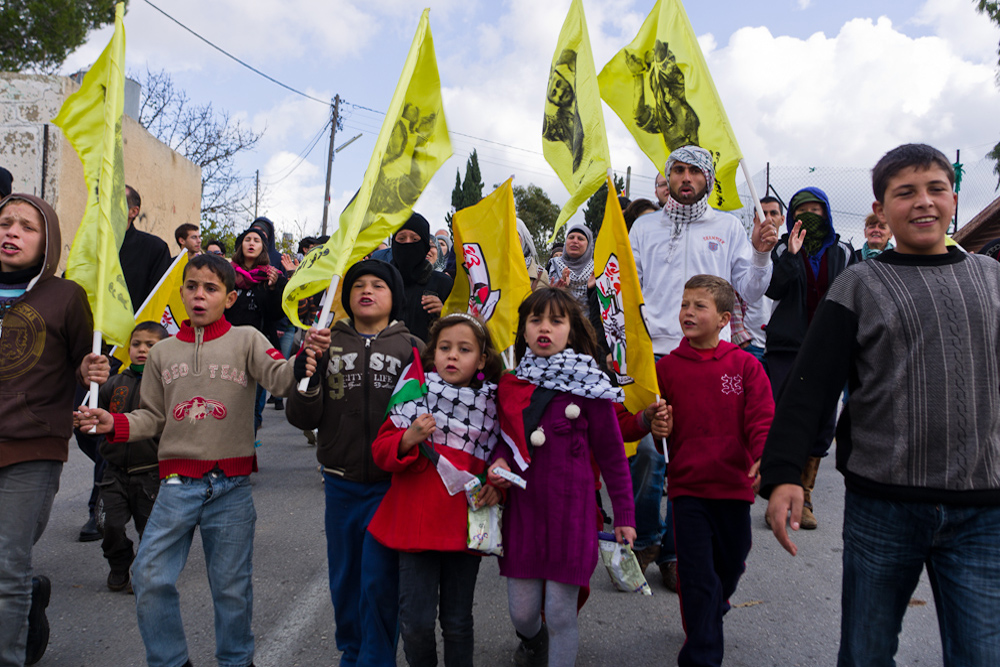
Weekly protest in Bil'in, June 2011 (Anna Paq, courtesy of ActiveStills.org)
Writing on July 19 in a column intended to “correct a few common misconceptions” about the Israeli-Palestinian conflict, Nicholas Kristof perpetuated one of his own. Offering unsolicited advice to Palestinian political leaders, Mr. Kristof wrote: “If Palestinians turned to huge Gandhi-style nonviolence resistance campaigns [sic], videos would reverberate around the world and Palestine would achieve statehood and freedom.” Mr. Kristof’s sentiment is admirable. His glaring ignorance of ongoing Palestinian peaceful grassroots campaigns is not.
At a time of colossal regional violence, the growth of peaceful grassroots campaigns for Palestinian statehood and civil rights is one of the few uplifting stories in Israeli-Palestinian politics. Over the past decade, these campaigns have originated in communities with particular grievances, and slowly transformed into weekly marches for civil rights and statehood. In Bil’in, Palestinians have marched every Friday since February 2005, when community members first organized in defiance of the expropriation of half of the village’s farmland by the neighboring Modiin Illit settlement (the Israeli High Court returned one-half of the stolen land in 2007). Those demonstrations were featured in the Academy Award–nominated documentary 5 Broken Cameras, one of the few instances of global media attention on Palestinian peaceful protests. In Nabi Saleh, weekly marches have protested a similar expropriation of land, and the denial of basic civil rights by military rule. Other active villages include Budrus, Jayyous, Beit Surik, Biddo, Al-Wlajeh, Ni’lin, Ma’sara, Beit Ummar, and Iraq Burin, among others. Weekly demonstrations include anywhere from several dozen to several hundred protesters.
Weekly marches have not been the only Palestinian peaceful campaigns. Other methods include barricading roads on which Palestinians are not permitted to drive, mass prayer events, and hunger strikes. The Popular Struggle Coordination Committee serves as an umbrella organization for these efforts, coordinating “marches, strikes, demonstrations, direct actions and legal campaigns, as well as supporting boycott, divestment and sanctions,” according to its website. Some peaceful protesters have also worked with American and European counterparts to organize international demonstrators, such as a series of demonstrations on April 15, 2014, to protest use of U.S. tax funds to support the Israeli occupation.
The leaders who have emerged from these movements speak the Gandhian language of transformative nonviolence that Mr. Kristof implores them to employ. When I was in Bil’in last month, leading activist Iyad Burnat explained his philosophy of nonviolence to me: “I want my freedom, and I am not free if I harm another person.” Another activist in Bil’in, who preferred not to be named for fear of reprisal, told me: “If you want to visit my home, I do not care if you are Muslim, Jewish, or Christian. But you cannot bring violence with you, you cannot solve disputes with violence. That is our message to the Israelis who occupy us.”
While Mr. Kristof is wrong that Palestinians have yet to learn the value of peaceful grassroots campaigns, he is right that the Gandhi-like Palestinian movement is not “huge.” Why haven’t more Palestinians joined the movement? One theory is that Palestinians refuse to reject militancy. Another is that they fear the draconian violence visited upon peaceful protesters by the Israel Defense Force.
To understand why more Palestinians haven’t joined weekly peaceful protests, it’s important to consider something that Mr. Kristof likely overlooked in formulating his advice: Israeli Military Executive Order 101 outlaws political gatherings of more than ten Palestinians in the West Bank, meaning that Palestinian peaceful gatherings inherently amount to illegal civil disobedience. Unsurprisingly, the Israel Defense Forces responds to these protests with force as a matter of policy. Nearly every Friday in the Palestinian villages in which demonstrations occur, the IDF unleashes an occasionally lethal, always perilous, combination of tear gas, rubber-coated bullets, water cannon–fired “skunk” liquid, and—sometimes—live fire. Onestudy found that between 2004 and 2011, thirteen Palestinian civilians were killed in nonviolent demonstrations; Iyad Burnat, the Bil’in organizer, puts the overall figure at closer to forty.
The IDF also punishes villages known for nonviolent civil disobedience campaigns in other ways. Nonviolent demonstrators have been arrested and imprisoned for “incitement”; children can be detained and processed in the IDF’s notoriously gruesome military court system, whose treatment of children UNICEF has called “cruel, inhumane and degrading”; and permits for work in Israel can be revoked. The IDF has confirmed that it uses collective punishment against villages in which these protests occur. It turns out that there are substantial costs to even peaceful resistance against the state that controls your access to water, electricity, transportation, employment, and freedom of mobility. In this context, what seems remarkable is not that more Palestinians do not join the demonstrations, but that so many have persevered over the past decade.
These harsh IDF responses are not provoked by Palestinian violence. A leaked 2010 U.S. State Department memo records Israel’s top military official in the West Bank, General Avi Mizrahi, promising to use skunk water and mass arrests to quell “even demonstrations that appear peaceful.” As one senior Israeli military official told an American counterpart in 2011: “We don’t do Gandhi very well.”
While Israel’s response to Gandhi-style tactics has been utterly condemnable, Palestinians have certainly not perfected the tactic. Kristof writes that “too many Palestinians define nonviolence to include rockthrowing. No, that doesn’t cut it.” Mr. Kristof is right that occasional rock-throwing does occur, but he is thoroughly wrong to define and dismiss the movement by this practice. Stone-throwing is not employed as an organized strategy of demonstrators, who use marches and sit-ins to make their point; those who throw stones tend to act alone or in small groups, and often after the IDF initiates violence against peaceful demonstrators.
The relentless emphasis on stone-throwing cedes any sense of proportionality, ignoring the egregious violence with which the IDF crushes Palestinian demonstrations by official policy. As Iyad Tamimi, a leading organizer in Nabi Saleh, told me when I visited the village last month: “After one day of protest, we pick up 1,500 tear gas canisters. Are the Israelis nonviolent?”
To substantiate his claim about rock-throwing, Mr. Kristof turns not to a third-party report, but instead links to the official IDF blog. On that page, the IDF misleadingly boasts of “protecting the right of Palestinians to protest peacefully,” despite the fact that Israeli military law explicitly denies Palestinians the right to political demonstration.
Of course, it would be ideal for no rock-throwing to occur, just as it would be ideal for the IDF not to resort to violence in crushing popular demonstrations, just as it would be ideal, writ large, for the IDF to withdraw from the West Bank, which it occupies in contravention of international law. But demanding that Palestinians absorb the tremendous personal costs of nonviolent civil disobedience, then dismissing the promising movement because of marginal stone-throwing, all while ignoring the vast IDF violence against Palestinian civilians—this is not the empathy Mr. Kristof has offered to others struggling for human rights around the globe.
This brazen disproportionality is precisely why Mr. Kristof’s advice is so insulting. In the past decade, Palestinians living under a grinding military occupation have undertaken profound personal and community sacrifices to organize peaceful demonstrations for civil rights and statehood. Instead of empowering these courageous moderates by sharing their stories, Mr. Kristof turns a blind eye, dismissing the cost of their courage while arrogantly suggesting that he will pay attention when Palestinians learn to behave perfectly.
It’s this type of superficial media coverage that makes so preposterous Mr. Kristof’s prediction that “the resulting videos [of nonviolence resistance campaigns] would reverberate around the world and Palestine would achieve statehood and freedom.” Thevideos are here, here, here, and here, among other places, Mr. Kristof. Will you start sharingthem?
Sam Sussman co-directs Extend, an American start-up non-profit organization that offers five-day educational tours of the West Bank to young American Jews. He is an M.Phil. candidate in International Relations at Oxford. He tweets @SamSussman1.