Wednesday, February 23, 2011

198 Forms of NonViolent Resistance


198 Methods of Nonviolent Action
These methods were compiled by Dr. Gene Sharp and first published in his 1973 book, The Politics of Nonviolent Action, Vol. 2: The Methods of Nonviolent Action. (Boston: Porter Sargent Publishers, 1973). The book outlines each method and gives information about its historical use.

You may also download this list of methods.

THE METHODS OF NONVIOLENT PROTEST AND PERSUASION

Formal Statements
1. Public Speeches
2. Letters of opposition or support
3. Declarations by organizations and institutions
4. Signed public statements
5. Declarations of indictment and intention
6. Group or mass petitions

Communications with a Wider Audience
7. Slogans, caricatures, and symbols
8. Banners, posters, and displayed communications
9. Leaflets, pamphlets, and books
10. Newspapers and journals
11. Records, radio, and television
12. Skywriting and earthwriting

Group Representations
13. Deputations
14. Mock awards
15. Group lobbying
16. Picketing
17. Mock elections

Symbolic Public Acts
18. Displays of flags and symbolic colors
19. Wearing of symbols
20. Prayer and worship
21. Delivering symbolic objects
22. Protest disrobings
23. Destruction of own property
24. Symbolic lights
25. Displays of portraits
26. Paint as protest
27. New signs and names
28. Symbolic sounds
29. Symbolic reclamations
30. Rude gestures

Pressures on Individuals
31. "Haunting" officials
32. Taunting officials
33. Fraternization
34. Vigils

Drama and Music
35. Humorous skits and pranks
36. Performances of plays and music
37. Singing

Processions
38. Marches
39. Parades
40. Religious processions
41. Pilgrimages
42. Motorcades

Honoring the Dead
43. Political mourning
44. Mock funerals
45. Demonstrative funerals
46. Homage at burial places

Public Assemblies
47. Assemblies of protest or support
48. Protest meetings
49. Camouflaged meetings of protest
50. Teach-ins

Withdrawal and Renunciation
51. Walk-outs
52. Silence
53. Renouncing honors
54. Turning one's back


THE METHODS OF SOCIAL NONCOOPERATION

Ostracism of Persons
55. Social boycott
56. Selective social boycott
57. Lysistratic nonaction
58. Excommunication
59. Interdict

Noncooperation with Social Events, Customs, and Institutions
60. Suspension of social and sports activities
61. Boycott of social affairs
62. Student strike
63. Social disobedience
64. Withdrawal from social institutions

Withdrawal from the Social System
65. Stay-at-home
66. Total personal noncooperation
67. "Flight" of workers
68. Sanctuary
69. Collective disappearance
70. Protest emigration (hijrat)


THE METHODS OF ECONOMIC NONCOOPERATION: (1) ECONOMIC BOYCOTTS

Actions by Consumers
71. Consumers' boycott
72. Nonconsumption of boycotted goods
73. Policy of austerity
74. Rent withholding
75. Refusal to rent
76. National consumers' boycott
77. International consumers' boycott

Action by Workers and Producers
78. Workmen's boycott
79. Producers' boycott

Action by Middlemen
80. Suppliers' and handlers' boycott

Action by Owners and Management
81. Traders' boycott
82. Refusal to let or sell property
83. Lockout
84. Refusal of industrial assistance
85. Merchants' "general strike"

Action by Holders of Financial Resources
86. Withdrawal of bank deposits
87. Refusal to pay fees, dues, and assessments
88. Refusal to pay debts or interest
89. Severance of funds and credit
90. Revenue refusal
91. Refusal of a government's money

Action by Governments
92. Domestic embargo
93. Blacklisting of traders
94. International sellers' embargo
95. International buyers' embargo
96. International trade embargo


THE METHODS OF ECONOMIC NONCOOPERATION: (2)THE STRIKE

Symbolic Strikes
97. Protest strike
98. Quickie walkout (lightning strike)

Agricultural Strikes
99. Peasant strike
100. Farm Workers' strike

Strikes by Special Groups
101. Refusal of impressed labor
102. Prisoners' strike
103. Craft strike
104. Professional strike

Ordinary Industrial Strikes
105. Establishment strike
106. Industry strike
107. Sympathetic strike

Restricted Strikes
108. Detailed strike
109. Bumper strike
110. Slowdown strike
111. Working-to-rule strike
112. Reporting "sick" (sick-in)
113. Strike by resignation
114. Limited strike
115. Selective strike

Multi-Industry Strikes
116. Generalized strike
117. General strike

Combination of Strikes and Economic Closures
118. Hartal
119. Economic shutdown


THE METHODS OF POLITICAL NONCOOPERATION

Rejection of Authority
120. Withholding or withdrawal of allegiance
121. Refusal of public support
122. Literature and speeches advocating resistance

Citizens' Noncooperation with Government
123. Boycott of legislative bodies
124. Boycott of elections
125. Boycott of government employment and positions
126. Boycott of government depts., agencies, and other bodies
127. Withdrawal from government educational institutions
128. Boycott of government-supported organizations
129. Refusal of assistance to enforcement agents
130. Removal of own signs and placemarks
131. Refusal to accept appointed officials
132. Refusal to dissolve existing institutions

Citizens' Alternatives to Obedience
133. Reluctant and slow compliance
134. Nonobedience in absence of direct supervision
135. Popular nonobedience
136. Disguised disobedience
137. Refusal of an assemblage or meeting to disperse
138. Sitdown
139. Noncooperation with conscription and deportation
140. Hiding, escape, and false identities
141. Civil disobedience of "illegitimate" laws

Action by Government Personnel
142. Selective refusal of assistance by government aides
143. Blocking of lines of command and information
144. Stalling and obstruction
145. General administrative noncooperation
146. Judicial noncooperation
147. Deliberate inefficiency and selective noncooperation by enforcement agents
148. Mutiny

Domestic Governmental Action
149. Quasi-legal evasions and delays
150. Noncooperation by constituent governmental units

International Governmental Action
151. Changes in diplomatic and other representations
152. Delay and cancellation of diplomatic events
153. Withholding of diplomatic recognition
154. Severance of diplomatic relations
155. Withdrawal from international organizations
156. Refusal of membership in international bodies
157. Expulsion from international organizations


THE METHODS OF NONVIOLENT INTERVENTION

Psychological Intervention
158. Self-exposure to the elements
159. The fast
a) Fast of moral pressure
b) Hunger strike
c) Satyagrahic fast
160. Reverse trial
161. Nonviolent harassment

Physical Intervention
162. Sit-in
163. Stand-in
164. Ride-in
165. Wade-in
166. Mill-in
167. Pray-in
168. Nonviolent raids
169. Nonviolent air raids
170. Nonviolent invasion
171. Nonviolent interjection
172. Nonviolent obstruction
173. Nonviolent occupation

Social Intervention
174. Establishing new social patterns
175. Overloading of facilities
176. Stall-in
177. Speak-in
178. Guerrilla theater
179. Alternative social institutions
180. Alternative communication system

Economic Intervention
181. Reverse strike
182. Stay-in strike
183. Nonviolent land seizure
184. Defiance of blockades
185. Politically motivated counterfeiting
186. Preclusive purchasing
187. Seizure of assets
188. Dumping
189. Selective patronage
190. Alternative markets
191. Alternative transportation systems
192. Alternative economic institutions

Political Intervention
193. Overloading of administrative systems
194. Disclosing identities of secret agents
195. Seeking imprisonment
196. Civil disobedience of "neutral" laws
197. Work-on without collaboration
198. Dual sovereignty and parallel government

Source: Gene Sharp, The Politics of Nonviolent Action, Vol. 2: The Methods of Nonviolent Action (Boston: Porter Sargent Publishers, 1973).

Sunday, February 13, 2011

Women in Italy speak up against the sexism of President Berlusconi


"If Not Now, When?" was a national demonstration of Italian women, against Berlusconi and, to put it bluntly, his porno-democracy. The demo had other slogans as well: Resign! Basta! I don't give up! ADESSO, NOW!

A flash mob in 280 cities of Italy and 50 cities abroad, millions of people, mostly women, but also men and children. The demonstrations have been growing in the months since Berlusconi got caught up in the sex scandal vertigo with minors, prostitutes, pimps and orgies.

A week ago in Milan, in a big rally, the prominent intellectuals in Italian public life threw themselves into the campaign: the distinguished professor and writer Umberto Eco, Roberto Saviano the star of the antimafia campaign, the judges of of the constitutional court, trade union leaders and many others. But as one of the speakers, the orchestra director Pollini remarked : Berlusconi will never step down.

Berlusconi did not leave public life. On the contrary, he sped up his counter-campaign, attacking the judges in Milan who brought the latest of many legal cases against him. He even threatened to take his case to the European Parliament and sue the nation of Italy. He organized rallies in his support , claiming that his innocent altruistic interest in young girls had been cruelly misunderstood. He also accused the investigators of orchestrating a communist-biased coup against himself as head of government.

But his luck may be turning these days, after sixteen long years of media monopoly and political domination. Even the Catholic daily, Avvenire, came out with a big editorial claiming that decent Catholic women should be in the public squares on the 13th of February. It's rare of the Church to urge women to take to the streets to defend their dignity. Then there is the dignity of the state to consider, for the ludicrous shambles of Italian public life has become a matter of international concern.

A British comment in the Guardian justly noted that European Union as the monitor of high democratic standards within the community of states. Yet while they preach good governance to applicant countries like Turkey and Serbia, they ignore the calamitous decline of democracy in Italy, an EU founding state. Italy has become a European laughingstock, all harems, dictators, old men and underage girls.

An irate 18 year old guy in Italy demanded publicly: how am I supposed to get a girlfriend of my own age, since Berlusconi, the grandad of the nation, is buying them all? I don't have his years, his money and power, I don't even have a job or a decent education. University and hospital funds are cut, jobs are in recession and Berlusconi's parliamentary allies are cutting the country apart with regionalist laws. Berlusconi' s government still holds the majority in the parliament. The president of Italy had to admonish him that the country is not his private property.

The president also alleged that Italian democratic institutions are sound, but clearly Berlusconi doubts that and so do the millions of Italians today in the squares all over Italy. In Torino, the capital of Italy in its unification years ago, a protester said: we are the head of the boot extending toward Africa.

The demo today lacked party or ideological symbols: it was a flash mob with umbrellas and screams; RESIGN. It was extremely successful, unitary and grand. It brought out of the closet what is left of Italian decency after long reign of a small macho dictator, who has publicly realized the worst dreams of Italian macho culture. As a woman demonstrator put it: some men after all do prefer a partner to a harem.

Today women of all ages and political opinions were in the squares and streets; I saw Italian women, foreign women, clandestine women, special needs women, female beggars and hobos, girls, babies, even nuns!...and I saw men, boys, old men... The performance was to open the umbrellas, scream RESIGN and spread colorful woolen threads among the crowd to bind those different people. Music played: Patti Smith, Fabrizio de Andre. Girl bloggers asked for a ban of internet use of nude bodies. Women have a value, not a price! Men made fun of their macho patriarchal language with banners and in drag clothes. Pornocrazia!

Today 13th February is the "international day of mistresses." Tomorrow it's Valentine's day, the day of love. Whatever this meeting will bring to future of Italy and the reign of Berlusconi, it's clear beyond doubt that nobody doubts Berlusconi's guilt. They despise his use and abuse of girls and money. Now the big question is -- does public indignation matter? The old Sultan will leave his thone someday, and if not now, when?

Women toppled their rich, remote, corrupted regimes in Tunisia and Egypt. If not here, where? So why not in Italy too?

Jasmina's blog: jasminatesanovic.wordpress.com

Thursday, February 3, 2011

Egypt Women Show Courage Participating In Mubarak Protests


http://www.huffingtonpost.com/2011/02/02/egypt-women-protests_n_817822.html
Jake Bialer      HuffPost Reporting
jake@huffingtonpost.com 
Emacs!

First Posted: 02/ 2/11 07:33 PM Updated: 02/ 3/11 11:39 AM
"If I wasn't pregnant, I would've just stayed home." Marwa Rakha told the Huffington Post by phone, explaining her attendance of the protests inEgypt while seven months pregnant. "I went out because of my baby. I owe this to him."

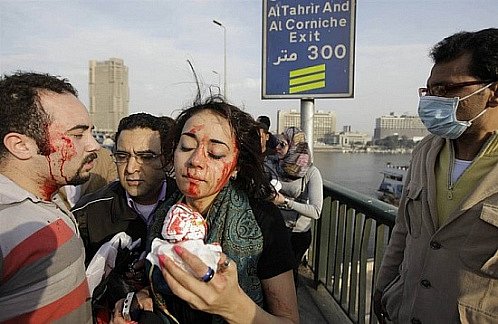
Rakha, an adjunct professor at the American University in Cairo, is one of many women who has participated in the recent protests in Egypt. In these demonstrations, which have already led to Mubarak agreeing not to run for re-election, women have taken an active role: promoting them, leading crowds, and providing aid to harmed protesters.

This is in a country where women typically don't have a large public role. Before their last election, Al Jazeera reported that even with election reforms, women would only hold 12 percent of the seats in the Egyptian parliament:

Last year, the assembly passed a law mandating the creation of 64 new seats in the house that must go to women. With only four women elected in 2005, that means parliament's female cadre will leap by a whopping 1,500 percent, and 12 percent of the new house will consist of women.
The Atlantic's Garance Franke-Ruta characterizes Egypt as "a country in which men and women are barely tolerated holding hands in public in the most liberal precincts of comparatively Christian Alexandria, and where public displays of affections are frowned upon and likely to be met with cutting glances and vicious neighborhood gossip elsewhere."

But in the recent wave of protests in Egypt, women have been important contributors and have been accepted by their male counterparts.

ABC News reported earlier that unlike past Egyptian protests, these protests were largely free of sexual harassment.

"Egyptian state TV was spreading rumors that in the protests girls were being sexually harassed," said Rakha. "That's a complete lie. In those protests, I've witnessed Egyptians that I didn't think still existed. They're very supportive of one another. If a girl fell, they would just pick her up, help her, no sexual harassment of any sort."

Rakha said she went to the protests alone.

"I just took my cell phone and went," she said. "I met people and we just began talking, regardless of our religion, regardless of our gender, regardless of our age, regardless of our social class, regardless of anything, we were Egyptians out there who were very angry at lies we've been fed for the last 30 years."

Anna Day, a 22-year-old American M.A. student who is studying conflict resolution, who is writing freelance on the Palestinians and lives in Israel-Palestine, traveled down to Egypt from Israel to attend and document the protests.

Day told The Huffington Post by phone she stood out amongst the crowd. "Everyone wanted to talk to me because I was like the only white person there and I have blonde hair so I looked ridiculous," she said.

Having previously lived in Cairo, she "didn't expect many women to be at these protests," and she was surprised by the involvement of women in the protests. "Women were leading the chants and men were responding which I didn't expect to see in Cairo," she said.

Women's role in the protests wasn't limited to their activity on the street, they were also involved in the online campaigns that led up to the protests. The New York Times reported on Asmaa Mahfouz who used social media to help spread the message of the protests.

That's not to say women were the majority of the protesters. "If you look at the pictures, it's clearly mainly men," Day said. "But for the society of Egypt, the number of women at these protests and their role, they were at the front with tear gas and everything, their role was not something I expected to see."

The majority of women have been avoiding the more dangerous events. "In the evenings, I didn't see as many women out at nighttime," Day added. "At nighttime, it just does set a different mood. People get a little angrier, a little crazier, so I haven't seen women in the nighttime at the same rates as I've seen men."

The number of female participants are in the protests are hard to determine. Slate looked into the participation at the protests on Tuesday:

"Ghada Shahbandar, an activist with the Egyptian Organization for Human Rights, estimated the crowd downtown to be 20 percent female. Other estimates were as high as 50 percent. In past protests, the female presence would rarely rise to 10 percent."
But the anecdotal evidence of their participation is everywhere. A "Women of Egypt" Facebook group has emerged to collect pictures of women at the protests. The Global Post has published photos of women. There have been photos of women kissing police officers. They've beeninterviewed. And they've been shown alongside men in videos.

According to Day, women helped treat protesters who were overwhelmed by tear gas using Pepsi.

"If you put Pepsi in your eyes, it neutralizes the pain of the teargas," she said. "These cars full of protesters were bringing Pepsi and water to the protesters."

It was women who discovered the Pepsi trick, Day said. "They're bringing Pepsi and helping people back, putting Pepsi in people's eyes."

Despite their increased role, the women still weren't the rowdiest participants. "They aren't the ones on top of government vehicles holding Egyptian flags," Day said.

But, as the Egyptian feminist Nawal El Saadawi told Democracy Now, "Women and girls are beside boys in the streets."


Follow our Egypt live blog here and learn about the unrest with our Egypt revolution guide.

You can also send us Egypt tips anytime at egypt@huffingtonpost.com or by leaving a message at 00-1-315-636-0962.


Read More: EgyptEgypt ProtestsEgypt Protests 2011Egypt RevolutionEgypt WomenEgypt Women ProtestsEgyptian WomenWomen EgyptWomen In EgyptWomen Of EgyptWorld News


Around the Web:

[]  Women in Egypt - Wikipedia, the free encyclopedia

[]   Egypt Protests: Sexual Harassment of Women Drops, Witnesses Say ...

[]   The Female Factor - In Egypt, Women Have Burdens but No Privileges ...

[]   Where are Egypt's women? Right here. | FP Passport

[]   In Egypt, Some Women Say That Veils Increase Harassment ...

[]   Protests raise hope for women's rights in Egypt

[]   The role of women in the Egyptian democracy protests

Wednesday, February 2, 2011

Women of the Egyptian Revolution from sawt al niswa

http://www.sawtalniswa.com/2011/02/women-of-the-egyptian-revolution/This is a homage to all those women out there fighting on the streets of Egypt, to those whose voices and faces were hidden from the public eye during the first days of the revolution! The album by now has traveled the world back and forth via online social networks, blogs and websites.Patience and modesty are highly appreciated.


First and foremost the credit for this album goes to the courageous people of Egypt who are teaching us that freedom is taken and not given.

Second, to the women who by their courage, determination and strength are inspiring millions of us around the world.

Third to the photographers who took these photos and especially to those who have caused absolutely no problems when it came to copyright issues.

Fourth, to the amazing web of people who have been sending me photos and captions for the album, and to those who are sending corrections of mistakingly posted or labeled photos.


This compilation is meant to further shed the light on the Egyptian people´s strife for freedom, and the complicity of the world governments with the Mubarak regime. It is meant as a call for action and active solidarity with the Egyptian people. A call to protest companies like Vodafone and Orange/France Telecom who have left the Egyptian people incommunicado in the face of a brutal and a repressive regime. The world governments and big corporations have ignored the voices of millions of Egyptians, and the voices of millions of us worldwide and continue to further support and whitewash the crimes of the dictatorship, both vocally and silently.

This album is just a small reminder of what is happening right now, as you are reading this, on the streets of Egypt. A hint of the grassroots and popular revolution facing up to around 41 years of a totalitarian regime, a dictatorship and emergency laws (around 11 years under Sadat, and around 30 years under Mubarak)

It is also very important to highlight the first spark of it all, the Tunisian revolution and its women. To stress that we should not shift our attention from them. They are still fighting and the battle is not over yet. Here is a link to a photo-stream from Le Monde / France in total admiration of the inspiring and courageous women of Tunisia http://ow.ly/3MDyZ

It is important to note that I did NOT TAKE ANY of these photos and that neither I nor Sawt Al-Niswa have the rights to any of them. For any commercial usage we suggest getting in contact with the people who have the rights to them, agencies and photographers.

I´m trying to confirm that all the photos I´m receiving are from Egypt and that they were taken during the past week´s rebellion. It is not an easy task judging the amount of photos I´m receiving and the limited resources I have. If you identify any photo that is mistakingly posted here, or that is not from Egypt or from the ongoing revolution please don´t hesitate to contact me.

For photographers and agencies (a.k.a. Copyright information and the other excruciating reality)

As much as I don´t support nor agree with copyright, I know I´m legally bound to credit you for these photos and take permission to use them. But I hope you understand that the importance of giving visibility to the women in the Egyptian revolution comes before your commercial “rights”. And that this album is NOT being used in any commercial way (i.e. no one is making money out of your work, not a dime) But nevertheless, I´m trying to include the sources of all the photos in a way to acknowledge the work of the photographers and as a thread to who has the copyright for them (in case of agencies). If you see any of your photos here, and wish to be credited for it, please contact me with a clear reference to the photo and the corresponding credits. If your photo was mistakingly credited to someone else, I apologize, contact me and I will fix it.

Friday, December 31, 2010

Young girl Leek farmer in Afghanistan

For the last several years, a group of young Afghani’s in the Bamyan province of Afghanistan have been on “Our Journey To Smile” (http://ourjourneytosmile.com/blog/).  This journey to smile is their effort to bring about peaceful nonviolent solutions to conflicts in Afghanistan using the principles taught by Jesus, Gandhi, Martin Luther King, Jr. and others.

Who We Are


Who we are-
students-1v11
Afghan college students and youth who started this journey in 2008.
International volunteer for Journey to smile
International volunteeers who will participate in support of Our Journey to Smile.
To date, we have volunteeers from Singapore, Egypt, Italy and Nepal.
smiling-boy-v16
VENUE World Heritage Bamiyan Buddhas
LOCATION Bamiyan Afghanistan    DATE 21 September 2009
Our Journey to Smile in 2009 wishes to gather Afghan college students and Afghan youth from every ethnicity, as well as international volunteers from every country, to come together at the World Heritage Bamiyan Buddhas in Afghanistan on International Peace Day, 21st September 2009, to be an example and encouragement to the world that wide-scale humane relations based on a humane love is possible, however in-humane our current global situation may be.
So, we ask every one of you, to join or support Our Journey to Smile, knowing that the cumulative hope and conscience of humanity, once communally expressed on a wide enough scale, would demonstrate a love that inspires Mankind to grow and to be compassionately humane.
In 2009 AD, Afghanistan is in the depth of world conflict and self-interest.
Whatever our fellow humans, Obama or Osama or others, decide, the college students and youth of Afghanistan, together with all of humanity, wish to to encourage ourselves and others to SMILE.
By smiling, we are grieving over Mankind’s proud, in-humane and self-absorbed behavior. We seek to raise the possibility of a humane love by building wide scale humane relationships and thus enjoy the growth of a majority public practice of humanity’s shared hopes.
We hope to put courage and dignity into our lives and our world, to put delight into the hearts of children and all of Mankind, to suggest that whatever our shared condition, a HUMANE LOVE is possible.
While the US, NATO, Taliban and all other players decide what to do with a country that is not theirs and with a world that does not belong only to them, is there ANY ONE PERSON who understands what the common, average citizen of Afghanistan or citizen of the world wishes for?
Some say realistically but sadly, ‘this Journey will NOT happen….
What they are saying is ,’ Genuine love, humanity and peace belong only to the poets and the fables. Humanity doesn’t have what it takes.’
It’s sad because both Afghans and the world need encouragement.
It’s sad because reality, perhaps life itself, seems keen for us to remain frozen in the timid beliefs that humanity cannot have the HUMANE RELATIONS which the majority of us want, that the small minority of decision-makers must always have their self-interested ways.
We want to address our own cynicism, to try, to face disappointment, to take our small steps, believing that when we embark on Our Journey to Smile, humanity has to grow and will not shrink back to its unsure and undignified days.

Afghan Youth Peace Volunteer’s Journey To Smile Bringing the Reality of the War In Afghanistan to the United States

For the last several years, a group of young Afghani’s in the Bamyan province of Afghanistan have been on “Our Journey To Smile” (http://ourjourneytosmile.com/blog/).  This journey to smile is their effort to bring about peaceful nonviolent solutions to conflicts in Afghanistan using the principles taught by Jesus, Gandhi, Martin Luther King, Jr. and others.
These brave young Afghani men (and women) are aided by a humanitarian medical doctor from Singapore, Hakim, who previously worked for a Christian based NGO in Afghanistan, in the universal quest to promote nonviolence in a region that has been racked by almost constant violence since the 1970’s.  Douglas Mackey, from the FOR affiliate in the Olympia, WA area has been working with this group for well over one year.
Christian Peace Witness and other organizations have joined the effort to bring a few of the Afghan Youth Peace Volunteers to the United States this summer to share their story and their journey for nonviolence.  Unfortunately, their request for Visa’s has been denied by the United States government on the basis that the U.S. government feels that they are risks to over stay their visas and not return to Afghanistan.
While attempts are still being made to get them Visa’s, there are still plans being made for a “virtual” tour of the United States for the Afghan Youth Peace Volunteers this summer if the Visa’s are not obtained in a timely manner.  This virtual tour would consist of Josh Steiber, a young Iraq war veteran who became a Conscientious Objector, and others touring the U.S. and showing powerful films made by the Afghan youth, to various U.S. audiences and linking live to some of the Afghan youth so U.S. citizens attending these events have the opportunity to interact directly with these brave Afghan Youths who are working for non-violence.
Please go to “Our Journey to Smile” site (http://ourjourneytosmile.com/blog/) to learn more about these young Afghani’s and view some of their videos.  Also consider doing one or more of the following:
  • Contacting your Congress person, Senator, the State Department or White House and ask them to provide Visa’s for these young Afghani’s to come to the United States either this summer (or sometime else in the near future);
  • Considering hosting Josh and his traveling partners for an event to talk with the Afghani Youth from Afghanistan (or possibly another country they may visit this summer if the U.S. government continues to deny their VISA request).
  • If the tour does not come by to your geographical area, consider hosting a live interaction from your area during a time that the Afghan Youth Peace Volunteers will be speaking to another group in this country where Josh Steiber will be.  Your group would be able to ask questions and speak to the Afghan Youth and the other U.S. location live.
  • Consider helping to pay for this effort.  Fellowship of Reconciliation is collecting donations for Christian Peace Witness for this event.  Online donations can be made through the FOR website (http://www.forusa.org/) or checks can be mailed to FOR noting that the donation is for helping to fund the visit of the Afghan Youth Peace Fellowship to the United States (either physically or virtually).
Also, please pray for an end to United States military involvement in Afghanistan and for the success of the Afghan Youth Peace Volunteers in their journey to smile.

Tuesday, December 28, 2010

Christmas in Beit Sahour, Palestine

  From Mazin Qumsiyeh
I have spent 26 Christmases in our homeland but never had a more meaningful one than this one.   In the traditional 12 days of the holiday season, we finished with class work at Bethlehem University.  My masters' students and my undergraduate students did very well throughout the semester as they evolved their critical thinking and analytical skills and developed admirable self-confidence.  Then the holidays came and with them came people from around the world to join in our struggle for freedom.  In particular 73 French activists joined with others to attend and participate in a number of direct actions that challenge the colonial structure.  Starting on 22-23 December in Jerusalem, the group participated in direct action and other events in Shaikh Jarrah, Silwan, and ethnically cleansed villages behind the green line. After two nights in Jerusalem focusing on the increased pressures to isolate and destroy life for the remaining inhabitants of this Palestinian city, the activists were to come to Al-Walaja village (a village that suffers from colonial settlement activities on the small percentage of its land that remains after Israel took over 75%).  The Israeli apartheid army tried in vain to prevent the event from happening from preventing a bus company from transporting activists to blocking the road to the village to threatening people in the village.  Strong will and creative on-the-spot triumphed maneuvers frustrated the army's maneuver and all did in through other means to hold a huge demonstration of at least 200 people (Palestinians and Internationals including some Israelis). Not allowing empty buses to come to pick the demonstrators, we still managed to get everyone out safely to go the manger square for the traditional Christmas procession. With over 50 volunteers wearing bright yellow vests (Handala and Free Palestine prominently printed on them), we distributed over 2000 'Christmas Cards' to the Christian pilgrims.  The cards referred to the wish for peace with justice and linked to the Kairos document, a call by Palestinian Christians issued a year ago (see http://www.kairospalestine.ps)

Later in the afternoon, we traveled to Beit Jala where we shared putting-up a Christmas tree at the home of Abu Michel, a Christian whose land was taken over for the apartheid wall.  Then onto Aida refugee camp for a meaningful Christmas Eve with refugees. Christmas day was spent mostly in Hebron old city including in a demonstration against the racist settlers who continue to attempt to destroy the old city.  The occupation authorities used tear gas and stun grenades and kidnapped two internationals (French and a Scottish, both released later at night). Some Internationals joined us in the candle light march in the Shepherds' field that evening (over 2000 attended, a marvelous event; Above is a video of it
http://www.youtube.com/watch?v=34HiwC75MCU ). The next morning, activists went to Qalandia checkpoint and protested the Israeli army preventing Palestinians from entering Jerusalem.  A Palestinian and nine French activists were detained and many were beaten and injured (video here:
http://www.youtube.com/watch?v=VCpB54gcvUc ).  That afternoon, a tree planting event near the wall in Bil'in was met with Israeli tear gas and stun grenades (video here http://www.youtube.com/watch?v=L6uqb9ZuuCY ).
Later in the evening, we had an evening of camaraderie and solidarity despite attempts to politicize the event by some. The next day, the delegation visited Nablus (see photos at
http://www.europalestine.com/spip.php?article5724 ) and on the way back
stopped by Beitil and had a demonstration against the closure of roads
inside the west bank to Palestinian travel (photos at http://www.europalestine.com/spip.php?article5721 ). Two were detained and several injuries were reported due to the Israeli assault on the peaceful demonstration.  All detained in these various demonstrations were mistreated
but were eventually released.  

I urge all to come visit us and see what is happening in the "little town of Bethlehem": 170,000 people nearly half of them are refugees crowded into 13% of the original district size of Bethlehem and surrounded by 27 ft high walls and electrified fences.   Many people describe it as a Ghetto or a Bantustan (and the Israeli government calls such remaining Palestinian areas in the Negev and elsewhere as concentration areas).  But on the positive side, the pressure of the occupation and the test of us make us better human beings. The hundreds of internationals that participated in these activities told us how honored and leased they were by having shared a meaningful holiday season with us. Energized, we now planned much bigger activities for this summer (stay tuned).  Similarly, the Palestinians who participated in
the demonstrations or who even simply hosted internationals in their homes or who even saw us on TV or read about us in newspapers all felt a sense of hope and empowerment.  For me personally, having a house full of internationals sleeping everywhere eating together, working together, being attacked by occupation authorities together was the best Christmas gift. Come to think of it, that is what the message of that prince of peace born over two millennia years ago was about. We are the descendents of those first believing Shepherds who saw the star and believed in Jesus. Jesus born in a country called Palestine was thus Palestinian by birth but when he grew up he also challenged a Jewish ruler (Herod) put in place by a Western government.  History does repeat itself although with some variation but the message of love and peace will eventually triumph. This Christmas from here din the Shepherds' field just down the hill from the Church of Nativity, we sang "this in my heart, I do believe.we shall overcome someday" .. Merry Christmas.  by Mazin Qumsiyeh

Sunday, December 19, 2010

Veterans for Peace Are Arrested at the White House


Videos and other stuff from the action at the White House. To be clear, the organizers had no expectation of stopping the wars, changing government policy or even influencing public opinion. What we wanted was to keep the spirit of resistance alive and well, empower and encourage solidarity, which we did - and we had a good time doing it, arrests non-withstanding. Read Chris Hedges superb article for more on that.

No Act of Rebellion is Wasted http://www.truthdig.com/report/item/no_act_of_rebellion_is_wasted_20101213/

Ellen Davidson's pictures: http://picasaweb.google.com/ellen.rachel.davidson/CivilResistanceToWarsAtTheWhiteHouseOn121610#

http://www.allvoices.com/contributed-news/7642244-video-135-choose-arrest-at-white-house-as-veteranled-civil-resistance-demands-stop-these-wars/video/68878861-the-real-news-report-on-war-protest-at-white-house

http://www.allvoices.com/contributed-news/7642244-video-135-choose-arrest-at-white-house-as-veteranled-civil-resistance-demands-stop-these-wars

Democracy Now! http://www.youtube.com/watch?v=dfCaqqMyAfc

http://www.youtube.com/watch?v=3YQoydgMXkU

UPI http://www.upi.com/News_Photos/News/Veterans-For-Peace-protest-war-in-Afghanistan/4342/1/

Bill Perry's pics http://www.facebook.com/album.php?aid=338596&id=744057563&l=dc00ed2c77

Huffington Post
http://www.huffingtonpost.com/2010/12/15/ellsberg-antiwar-protesters-white-house-fence_n_797410.html

http://www.youtube.com/watch?v=n-S4SIre3kk

http://www.youtube.com/watch?v=WS6nPSOLyw4

http://rt.com/news/afghan-protests-white-house-obama/

Andrew Courtney's photo album: DC,VFP demo 12.16.10

http://www.opednews.com/articles/Daniel-Ellsberg-Ray-McGov-by-Rob-Kall-101218-333.html

www. stopthesewars.org

__._,_.___

Monday, December 13, 2010

Inmates in Georgia Prisons Use Contraband Phones to Coordinate Protest

By SARAH WHEATON  Published: December 13, 2010 U.S. NEWS
http://mobile.nytimes.com/article?a=713691&f=21

The prison protest has entered the wireless age.

Inmates in at least seven Georgia prisons have used contraband cellphones to coordinate a nonviolent strike this weekend, saying they want better living conditions and to be paid for work they do in the prisons.

Inmates said they would not perform chores, work for the Corrections Department's industrial arm or shop at prison commissaries until a list of demands are addressed, including compensation for their work, more educational opportunities, better food and sentencing rules changes.  The protest began Thursday, but inmates said that organizers had spent months building a web of disparate factions and gangs - groups not known to cooperate - into a unified coalition using text messaging and word of mouth.  Officials at the Georgia Department of Corrections said Monday that four facilities remain in a lockdown status and there have been no major incidents or issues reported.

Inmates complained of scattered clashes with guards.

Smuggled cellphones have been commonplace in prisons for years; Charles Manson was caught with one in a California penitentiary this month. Officials worry that inmates will use them to issue orders to accomplices on the outside or to plan escape attempts.

But the Georgia protest appears to be the first use of the technology to orchestrate a grass-roots movement behind bars.  Reached on their cellphones inside several prisons, six participants in the strike described a feat of social networking more reminiscent of Capitol Hill vote-whipping than jailhouse rebellion.

Conditions at the state prisons have been in decline, the inmates said. But "they took the cigarettes away in August or September, and a bunch of us just got to talking, and that was a big factor," said Mike, an inmate at the Smith State Prison in Downing who declined to give his full name.

The organizers set a date for the start and, using contact numbers from time spent at other prisons or connections from the outside, began sending text messages to inmates known to hold sway."  Anybody that has some sort of dictatorship or leadership amongst the crowds," said Mike, one of several prisoners who contacted The New York Times to publicize their strike.  "We have to come together and set aside all differences, whites, blacks, those of us that are affiliated in gangs."  Now, Mike said, every dormitory at participating prisons has at least one point man with a phone who can keep the other inmates in the loop.

Miguel, another prisoner at Smith who also declined to give his full name, estimated that about 10 percent of all inmates had phones." We text very frequently," he said. "We try and keep up with what's going on in the news and what's going on at other facilities. Those are our voices."

They are also a source of profit to the people providing the contraband. Miguel said he paid $400 for a phone that would have cost $20 on the street.  Mike said he bought his through a guard. "That's how a lot of us get our phones," Mike said.  Inmates said guards had started confiscating the phones, and they complained that hot water and heat had been turned off.

The Corrections Department placed several of the facilities where inmates planned to strike under indefinite lockdown on Thursday, according to local news reports.  "We're hearing in the news they're putting it down as we're starting a riot, so they locked all the prison down," said an inmate at Hays State Prison in Trion who refused to give his name.  But, he said, "We locked ourselves down."

The inmates contend that if they have a source of income in the prison and better educational
opportunities to prepare them for release, violence and recidivism will go down.  But the Department of Corrections has not publicly acknowledged the protest.

Mike said that the leaders were focused on telling inmates to remain patient, and not to consider resorting to violence.

The inmates' closest adviser outside prison walls is Elaine Brown, a longtime advocate for prisoners whose son is incarcerated at Macon State Prison, one of the other major protest sites.  A former Black Panther leader who is based in Oakland, Calif., Ms. Brown helped distill the inmate complaints into a list of demands.

She held a conference call on Sunday evening to develop a strategy with various groups, including the Georgia chapter of the National Association for the Advancement of Colored People and the Nation of Islam.
_______________________________________________ 

Sunday, December 12, 2010

The Writer's Almanac by Garrison Keillor, December 11, 2010

It's the birthday of writer Grace Paley, (books by this author) born in the Bronx (1922). Her parents were Jewish Socialist immigrants from Ukraine, Isaac and Manya Gutseit (which they changed to Goodside). They spoke Yiddish and Russian at home, and English in public; her father learned English by reading Dickens. Her family was affectionate and noisy — they loved to sing and to argue about politics. Young Grace absorbed different immigrant languages in the streets of the Bronx, and she loved listening to the gossip of family and friends and neighbors. She said: "The word gossip, which is considered so terrible, is really just another way of storytelling. And it's the way women tell stories, and it's kind of denigrated, 'cause its women who do it." And she said, "It is the responsibility of the poet to listen to gossip and pass it on in the way storytellers decant the story of life."
After high school, she took a class on English literature from W.H. Auden, who was her hero. During a lecture, he asked if there were any poets in the class who would like to meet with him and discuss their work. Out of 250 people, only five raised their hands, including Grace. She arranged to meet with Auden, and after an initial setback because she went to the wrong café, she did meet him and he read her poems, which she had written in his style, using British phrases and formal language. She said: "You understand I was a Bronx kid. We went through a few poems, and he kept asking me, do you really talk like that? And I kept saying, Oh yeah, well, sometimes. That was the great thing I learned from Auden: that you'd better talk your own language. Then I asked him what young writers now ask me — and I always tell them this story — I said to Auden, Well, do you think I should keep writing? He laughed and then became very solemn. If you're a writer, he said, you'll keep writing no matter what. That's not a question a writer should ask."
So she kept on writing poems, but she had plenty of other things in her life — she did occasional work as a typist, she was active in community projects, and she took care of her two young children. She had moved to Greenwich Village when she got married, and she spent many afternoons in Washington Square Park, hanging out with other mothers, hearing their stories. She would write down poems on scraps of paper, but she was too busy to think of writing anything much longer. Then she got sick, and she sent her kids to daycare so that she could recover. She had several days a week all to herself, so she started to write stories, drawing on the voices of the women she spent time with in the park every afternoon, writing about the kinds of events and characters that filled their lives.
She wrote three stories, and she showed them to a couple of people, including her friend Tibby McCormick, whose kids played with her kids. Tibby had just separated from her husband Kenneth McCormick, an editor at Doubleday, and Tibby guilt-tripped him into reading Paley's stories by telling him that their kids spent a lot of time hanging out at Paley's house and it was the least he could do. So he read them, and he came to see Paley and told that if she would write seven more stories, he would publish a book. And that was The Little Disturbances of Man (1959). Her first story in the collection, "Goodbye and Good Luck," begins: "I was popular in certain circles, says Aunt Rose. I wasn't no thinner then, only more stationary in the flesh. In time to come, Lillie, don't be surprised — change is a fact of God. From this no one is excused." The whole story had sprung from that single phrase, "I was popular in certain circles," which one of her aunts had said many years earlier. Paley said that she often based a story around a single line or phrase or way of speaking that rattled around in her head until she created a story for it.
She published just two more collections of stories, Enormous Changes at the Last Minute (1974) and Later the Same Day (1985). But she gained a devoted following, and when her Collected Stories was released in 1994, it was a finalist for the Pulitzer Prize and the National Book Award. She knew each story inside and out, and when someone would tell her that they loved one of her specific stories, her response was: "What's wrong with the rest?"
She never made her living as a writer alone. She taught at Sarah Lawrence and the City College of New York. And she was a passionate activist for social causes, protesting against nuclear proliferation and against wars from Vietnam to Iraq, and lobbying for women's rights. She said: "I think that any life that's interesting, lived, has a lot of pulls in it. It seems to me natural that I'd be pulled in those ways. [...] And you are privileged somehow to do as much as you can. I wouldn't give any of it up. And I've talked a lot about this with women's groups because I think that in whatever is gained, that everything, that the world should be gained. But that nothing should be given up. I think a good hard greed is the way to approach life."
She said: "You can't write without a lot of pressure. Sometimes the pressure comes from anger, which then changes into a pressure to write. It's not so much a matter of getting distance as simply a translation. I felt a lot of pressure writing some of those stories about women. Writers are lucky because when they're angry, the anger — by habit almost — I wouldn't say transcends but becomes an acute pressure to write, to tell. Some guy, he's angry, he wants to take a poke at someone — or he kicks a can, or sets fire to the house, or hits his wife, or the wife smacks the kid. Then again, it's not always violent. Some people go out and run for three hours. Some people go shopping. The pressure from anger is an energy that can be violent or useful or useless. Also the pressure doesn't have to be anger. It could be love. One could be overcome with feelings of lifetime love or justice. Why not?"

TO HEAR THE ENTIRE PROGRAM GO TO:
http://download.publicradio.org/podcast/writers_almanac/2010/12/twa_20101211_64.mp3?_kip_ipx=1245338883-1292186464

Wednesday, November 24, 2010

Village punished for non-violent demonstrations

Nov 19. 2010
This Friday in Nabi Saleh the Israeli border police used its stink water
tank in the center of the village, as a clear and gross collective
punishment measure against the entire village for Friday demonstrations.
Nabi Saleh residents and demonstrators in the village center, where the
stink water was squirted.

The stink water is a foul-smelling liquid that makes it unbearable to
live in the place where it is squirted on for at least one week. It is
not officially intended for use inside a populated area, but that has
been its use against Nabi Saleh residents and demonstration in the past,
and this gross attack is now being retained.

The demonstration in Nabi Saleh against the creeping annexation of land
by the Halamish settlement started with an immediate unprovoked attack
by Israeli border police on a peaceful and non-violent march. Following
this attack, clashes erupted, with some stone-throwers attempting to
ward off the army incursion. Nevertheless the army manage to position
itself just outside the village`s built area and shot its tear gas
canisters towards the village, repressing also non-protesting civilians.

Throughout the demonstration the Israeli army has shot tear gas
canisters directly at the protesters, a dangerous conduct which violates
even the army`s own regulations. Rubber-coated still bullets were also
widely used by the army. As a result at least 10 protesters suffered
injuries.