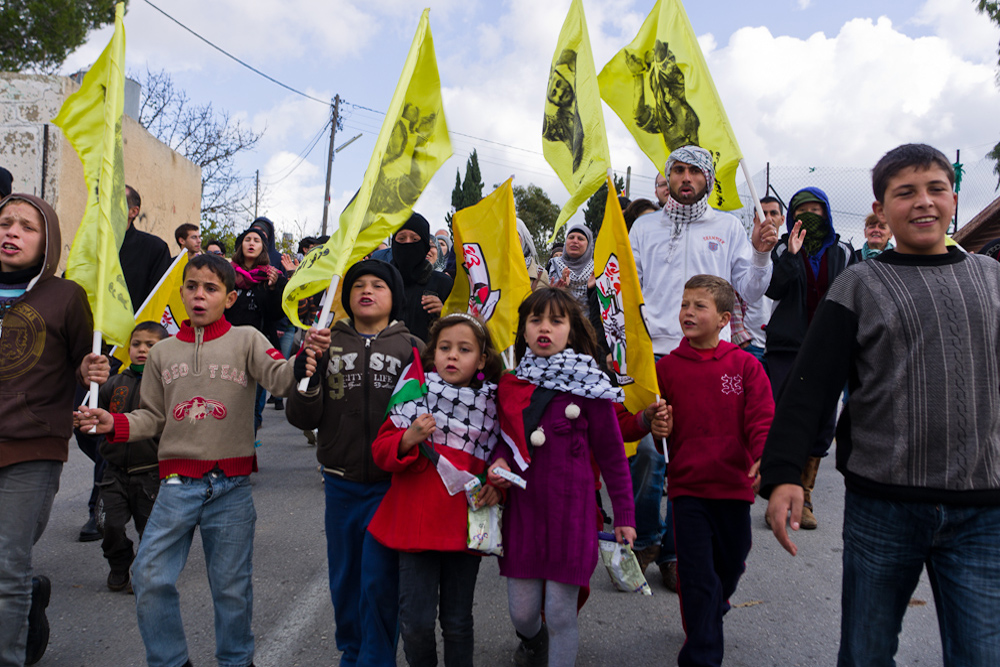
 Nabi Saleh, a small village of about 550 people, 20 km northwest of Ramallah in the West Bank, has been organising non-violent protests against land theft since 2009. On December 9, 2011, the Friday demonstration began as it always did: villagers, international and Israeli activists gathered in the centre of the village and marched towards land usurped by the Israeli settlement of Halamish. Soon after, the Israeli military drove to the entrance of the village in jeeps and began firing teargas at the protesters. Mustafa Tamimi, 28, was protesting with other young men from the village. As the jeeps stopped to let a bulldozer clear rocks that had been placed in the road to prevent their entrance, Tamimi and a few others moved closer to throw stones in a symbolic gesture against occupation.An Israeli soldier opened his door, aimed his gun and shot Tamimi directly in the face with an "extended range" teargas canister; he was shot from a distance of less than 10 metres, according to witnesses. Tamimi died from his injuries. Some experts trace conflict in the area back to 1976, when the illegal Israeli settlement of Halamish (or Neveh Tzuf) was established on land belonging to Nabi Saleh. Since then, the settlement has continued to grow and expand. In 2008, residents of the village challenged the construction of a fence by Israeli settlers on private Palestinian land. When the case was brought to Israeli court, it was decided that the fence must be removed. However, like many Israeli court rulings on Palestinian grievances, it was not upheld "on the ground" and the settlement continued to illegally annex Palestinian land. Soon after, settlers seized control of several springs which were all located on land belonging to Nabi Saleh residents. Today, around 13 per cent of the villagers has been arrested by Israeli authorities for participating in the demonstrations - including 29 children and four women. Recently, two prominent leaders of the non-violent struggle, Naji Tamimi and Bassem Tamimi, were arrested and remain prisoners in Israel. They are charged with "incitement" and organising "illegal" demonstrations.
| ||||||||||||||||||||||||||||
Showing posts with label Ramallah. Show all posts
Showing posts with label Ramallah. Show all posts
Sunday, December 11, 2011
When a non-violent protest ends in death


Tuesday, April 6, 2010
Non-Violence in Palestine?

By ETHAN BRONNER Published: April 6, 2010
RAMALLAH, West Bank — Senior Palestinian leaders — men who once commanded militias — are joining unarmed protest marches against Israeli policies and are being arrested. Goods produced in Israeli settlements have been burned in public demonstrations. The Palestinian prime minister has entered West Bank areas officially off limits to his authority, to plant trees and declare the land part of a future state.
The Palestinian prime minister, Salam Fayyad, said he planted trees in the West Bank last month “to establish our presence on our land and keep our people on it.”
Something is stirring in the West Bank. With both diplomacy and armed struggle out of favor for having failed to end the Israeli occupation, the Fatah-dominated Palestinian Authority, joined by the business community, is trying to forge a third way: to rouse popular passions while avoiding violence. The idea, as Fatah struggles to revitalize its leadership, is to build a virtual state and body politic through acts of popular resistance.
“It is all about self-empowerment,” said Hasan Abu-Libdeh, the Palestinian economy minister, referring to a campaign to end the purchase of settlers’ goods and the employment of Palestinians by settlers and their industries. “We want ordinary people to feel like stockholders in the process of building a state.”
The new approach still remains small scale while American-led efforts to revive peace talks are stalled. But street interviews showed that people were aware and supportive of its potential to bring pressure on Israel but dubious about its ultimate effectiveness.
Billboards have sprung up as part of a campaign against buying settlers’ goods, featuring a pointed finger and the slogan “Your conscience, your choice.” The Palestinian Ministry of Communications has just banned the sale of Israeli cellphone cards because Israeli signals are relayed from towers inside settlements. Prime Minister Salam Fayyad is spending more time out of his business suits and in neglected villages opening projects related to sewage, electricity and education and calling for “sumud,” or steadfastness.
“Steadfastness must be translated from a slogan to acts and facts on the ground,” he told a crowd late last month in a village called Izbet al-Tabib near the city of Qalqilya, an area where Israel’s separation barrier makes access to land extremely difficult for farmers. Before planting trees, Mr. Fayyad told about 1,000 people gathered to hear him, “This is our real project, to establish our presence on our land and keep our people on it.”
Nonviolence has never caught on here, and Israel’s military says the new approach is hardly nonviolent. But the current set of campaigns is trying to incorporate peaceful pressure in limited ways. Rajmohan Gandhi, grandson of the Indian independence leader Mahatma Gandhi, just visited Bilin, a Palestinian village with a weekly protest march. Next week, Martin Luther King III is scheduled to speak here at a conference on nonviolence.
On Palm Sunday, the Israeli police arrested 15 Palestinians in Bethlehem who were protesting the difficulty of getting to Jerusalem because of a security closing. Abbas Zaki, a senior official in the Palestine Liberation Organization, was arrested, prompting demonstrations the next day. Some Palestinians are also rejecting V.I.P. cards handed out by Israelis allowing them to pass quickly through checkpoints.
Palestinian political analysts say it is too early to assess the prospects of the nonviolent approach. Generally, they say, given the division between Hamas, the rulers of Gaza, and the Fatah-dominated Palestinian Authority here, nothing is likely to change without a political shakeup and unified leadership. Still, they say, popular resistance, combined with institution-building and international appeals, is gaining notice among Palestinians.
“Fatah is living through a crisis of vision,” said Mahdi Abdul Hadi, chairman of the Palestinian Academic Society for the Study of International Affairs in Jerusalem. “How can they combine being a liberation movement with being a governing party? This is one way. The idea is to awaken national pride and fulfill the people’s anxiety and passion. Of course, Hamas and armed resistance still remain a real option for many.”
Khalil Shikaki, who runs the Palestinian Center for Policy and Survey Research in Ramallah, said: “The society is split. The public believes that Israel responds to suffering, not to nonviolent resistance. But there is also not much interest in violence now. Our surveys show support for armed resistance at 47 percent in March. In essence, the public feels trapped between failed diplomacy and failed armed struggle.”
Israeli military authorities have not decided how to react. They allow Mr. Fayyad some activity in the areas officially off limits to him, but on occasion they have torn down what he has built. They reject the term nonviolent for the recent demonstrations because the marches usually include stone-throwing and attempts to damage the separation barrier. Troops have responded with stun grenades, rubber bullets, tear gas and arrests. And the military has declared that Bilin will be a closed area every Friday for six months to halt the weekly marches there.
“We respect Salam Fayyad,” one military official said, speaking under the army’s rules of anonymity. “But we don’t want him to engage in incitement. Burning goods is incitement. Destroying the fence is incitement and is not nonviolent. They are walking a thin line.”
One reason a violent uprising remains unlikely for now, Palestinian analysts say, is that in the two years that Mr. Fayyad’s security forces and ministries have been functioning, daily life inside West Bank cities and their surroundings has taken on much greater safety and normality.
The police and the courts are functioning again after the intifada of 2000 that led to many deaths on both sides. Traffic tickets are now routinely handed out. Personal checks, long shunned, are increasingly in use.
Of course, the presence of Israeli forces outside the cities and at checkpoints, the existence of the barrier and continued building inside Israeli settlements send most Palestinians into despair and make them doubt that a sovereign state can be built.
One effort to increase a sense of hope is a new push to ban goods made in the settlements, symbols of occupation. A $2 million project called the Karama National Empowerment Fund, jointly financed by Palestinian businesses and the government, aims to spread the message through ads and public events.
Mr. Abu-Libdeh, the economy minister, said a law was likely to go into effect soon barring the purchase of settlers’ goods, a trade worth at least $200 million a year. Efforts to end Palestinian employment in settlements will not carry penalties, he said, because the government does not offer unemployment insurance and it is unclear whether the 30,000 Palestinians who work in settlements could find new jobs.
Palestinian industrialists have financed the settlers’ goods ban partly because they hope to replace the goods with their own. They do not single out other Israeli goods, which are protected under trade agreements between Israel and the Palestinians.
Mr. Fayyad, the prime minister, a political independent, said his notion was to build the makings of a state by 2011.
“It’s about putting facts on the ground,” he said in an interview. “The occupation is not transitional so we need to make sure our people stick around. If we create services, it gives people a sense of possibility. I feel we are on a path that is very appealing both domestically and internationally. The whole world knows this occupation has to end.”
Tuesday, January 6, 2009
Children of Ni'lin Protest Gaza Attack
 This blog will post instances of non-violent actions for peace and justice from all over the world. Today these are some photos of a demonstration by children in Palestine.
From http://ramallahonline.com:
On Tuesday, the 6th of January 2009, the children of Ni’lin village, west of Ramallah held a protest against the Israeli military strike in Gaza. Dozens of kids waved flags and carried pictures of the casualties of their Gazan neighbours.

Those children know already what this is all about, as the town of Ni’lin has been facing a harsh repression against the weekly peaceful demontrations against the Wall for the last 6 months. There, Israeli violence killed a least 3 teenagers and dozens were injured and imprisoned.

 A child holds a picture of Arafat Khawaja who was shot by an IDF soldier at a demonstration in the village on December 28th 2008, during the protest against the Israeli military strike in Gaza.

Subscribe to:
Posts (Atom)

